HC
Karnataka High Court Quashes Criminal Case Against Advocate After Complainant Disowns Assault Allegations
Nyaya Prep • Published • Updated • 5 min read
The operative order
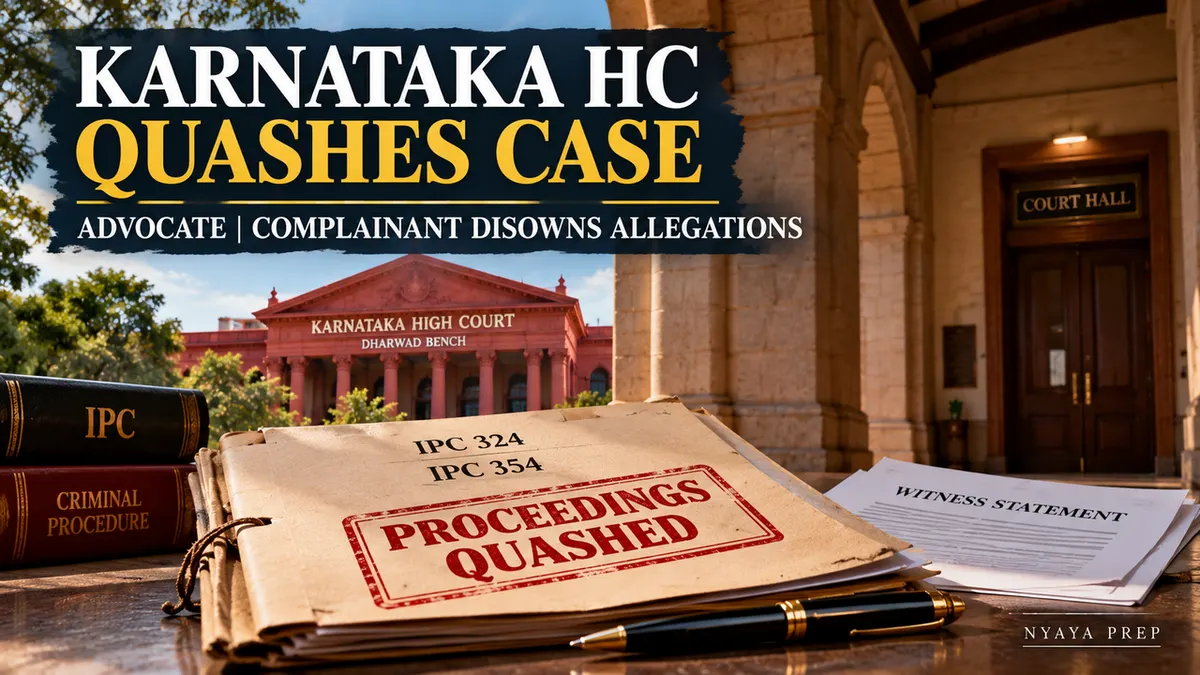
The Court allowed the advocate’s petition and quashed proceedings in C.C. No. 415 of 2022 arising from Crime No. 70 of 2021 of Hanumasagar Police Station, insofar as the petitioner was concerned. The charges under consideration were Sections 324 and 354 of the Indian Penal Code, 1860. The High Court used its inherent criminal jurisdiction to prevent continuation of proceedings it found legally unsustainable on the available record.
The order is specific to the petitioner and to the facts and charges before the Bench. It is not a declaration that every case must end when a complainant changes a statement. Courts must still examine the nature of the alleged offence, the material collected during investigation and whether the statutory ingredients can reasonably be established.
How the dispute arose
According to the prosecution account recorded in the judgment, the complainant had engaged the advocate to represent her in a divorce proceeding before the Family Court at Bengaluru. The parties later developed a personal relationship. An incident was alleged to have occurred on 29 June 2021, and the complainant lodged a police complaint the next day alleging abuse, assault and threats.
The police investigated and submitted a chargesheet against the advocate, while dropping two other accused persons. The magistrate took cognizance and issued process. The advocate then approached the High Court under Section 482 of the Code of Criminal Procedure, arguing that the complaint and later statement were materially inconsistent and did not disclose the offences invoked.
What the parties argued
Counsel for the advocate emphasised omissions and contradictions between the original complaint and the complainant’s further statement recorded during investigation. The petitioner submitted that the alleged acts did not satisfy Sections 324 or 354 IPC and that the criminal process should not continue. Those were defence submissions considered by the Court, not findings independently established merely by the filing of the petition.
The State opposed quashing, arguing that the chargesheet material disclosed offences and that the truthfulness of the allegations should be tested at trial. The High Court considered this objection but concluded that the legal ingredients were absent on the material it examined. Counsel for the complainant also appeared in the proceedings.
Why Section 324 was not made out
Section 324 IPC addresses voluntarily causing hurt by dangerous weapons or means. The High Court noted that the allegation did not describe the use of a dangerous weapon or any of the specified means contemplated by that provision. It also referred to the wound certificate, which showed no injuries on the complainant. The absence of the necessary statutory elements was central to its analysis.
The reasoning should not be shortened into a proposition that medical evidence is always indispensable to prove hurt. Here, the Court looked at the combined factual record, including the nature of the alleged act, the medical material and the precise charge under Section 324. The conclusion turned on whether the offence as charged was legally supported.
Why Section 354 was not made out
Section 354 IPC concerns assault or criminal force against a woman with the requisite intention or knowledge relating to outraging her modesty. The Court examined that mental element and referred to the Supreme Court decision in Raju Pandurang Mahale v. State of Maharashtra, reported at AIR 2004 SC 1677, when discussing the offence.
In the present case, the Bench found no allegation showing the requisite conduct and intention on the record as it stood. More importantly, it considered the complainant’s subsequent statement in which she categorically denied that the petitioner had assaulted her or committed an act outraging her modesty. That later statement was assessed alongside the other evidence, not in isolation.
The scope of inherent powers
The High Court held that continuation of the case would amount to an abuse of the process of law. Inherent jurisdiction is exercised with care because criminal trials ordinarily provide the forum for testing contested evidence. But a court may intervene where the allegations and collected material, taken in their proper legal context, do not make out the charged offence.
The judgment illustrates the importance of matching the facts alleged to the precise elements of a penal provision. Section 324 requires more than an unparticularised allegation of assault; Section 354 requires the legally specified conduct and mental element. The presence of a chargesheet does not eliminate the High Court’s responsibility to assess whether a prosecution is legally maintainable.
Practical significance
For investigators, the decision underlines the need to identify each ingredient of an offence and collect material relevant to it. For criminal practitioners, it shows why the original complaint, later statements, medical evidence and chargesheet must be read together when seeking or opposing quashing. The case also highlights that a court should distinguish a factual contradiction from a failure to allege an essential legal element.
The judgment is recorded as 2026:KHC-D:16064. It was pronounced on 25 September, not 30 October; the latter is the date of the newly published report. The operative order quashes the specified criminal proceedings against the petitioner, while broader questions about the credibility of complainants must continue to be decided case by case.
Case Details
Case: Somanath S. Hiremath v. State of Karnataka and Another
Citation: 2026:KHC-D:16064; Criminal Petition No. 100885 of 2023
Bench: Justice T. Venkatesh Naik, Dharwad Bench
Advocates: K. L. Patil for petitioner; Praveena Y. Devareddiyavara, HCGP, for State; Vidyashankar G. Dalawai for complainant
Relevant Bare Act
Indian Penal Code, 1860
Sections 324 and 354
Code of Criminal Procedure, 1973
Section 482
- Karnataka High Court
- IPC 324
- IPC 354
- Quashing
- Advocate
- Criminal Procedure