SC
Justice Sanjay Kumar Restricts Lawyers From Contacting Court Officers After Reported Abusive Phone Call
Nyaya Prep • Published • 4 min read
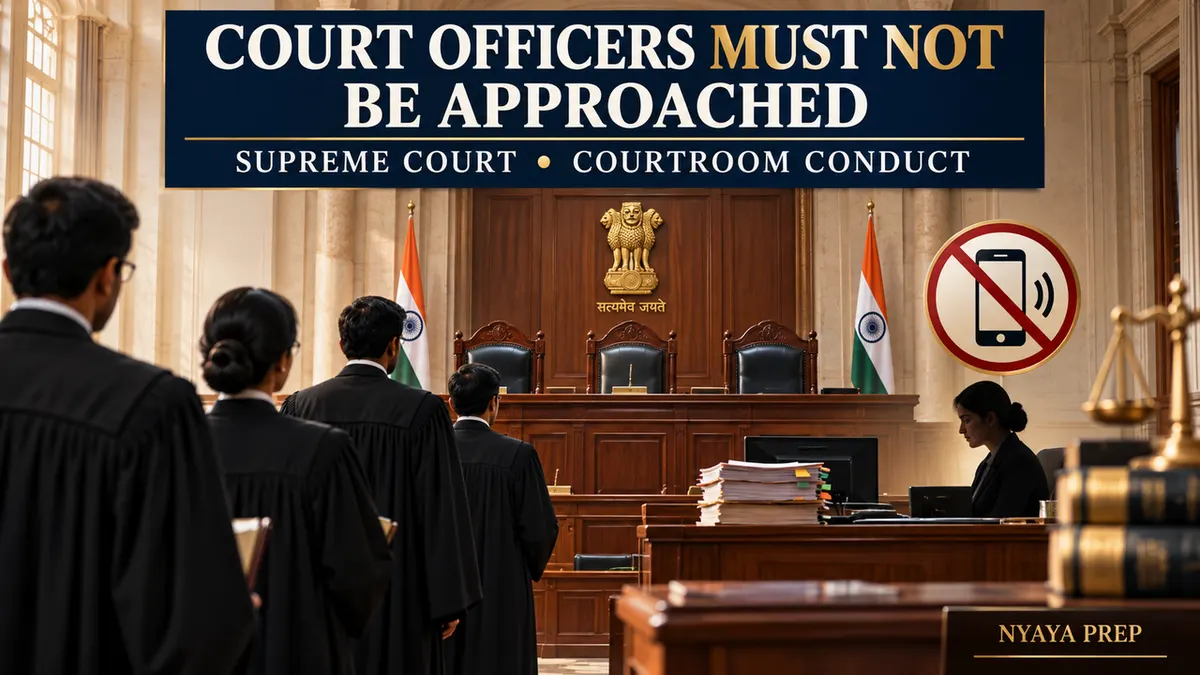
Restriction announced during morning mentioning
Justice Sanjay Kumar of the Supreme Court announced a restriction on direct approaches to officers attached to his courtroom during the morning mentioning session on 29 October 2026. The immediate trigger, as reported from the proceedings, was a telephone call in which the son of an advocate-on-record allegedly used abusive and insulting language toward a woman court officer. The judge questioned the advocate about the call and criticised the conduct.
The judge said that lawyers should not speak to the officers in person or by telephone and indicated that the court would arrange the relevant appearance formalities once the hearing of a matter concluded. His remarks were made in the setting of Court 8 and should not be described as a new Supreme Court-wide rule. No separately authenticated written administrative circular or signed order setting out the scope of the restriction was available for this report.
What happened in the courtroom
According to the account of the hearing, the judge called an advocate-on-record to address a complaint about the conduct of his son. The judge asked who had spoken to the woman officer and whether the advocate had taught his son appropriate manners. He objected not merely to the tone of the conversation but to the suggestion that court employees could be subjected to abuse while performing their duties.
The judge also referred to the possibility of the matter being brought to the attention of the association of advocates-on-record. That reference should not be confused with a verified disciplinary proceeding: the accessible account does not establish that a formal complaint, contempt notice or professional sanction was actually issued. The publicly reported development is the oral restriction and the judge’s comments during mentioning.
Why contact with court staff matters
Court officers perform practical and procedural work that enables hearings to proceed, including coordinating matters called before the Bench and processing court-related information. Their duties can expose them to pressure from lawyers and litigants seeking immediate updates or special access. Clear channels for communication help ensure that staff are not asked to give preferential treatment or respond to demands outside established procedures.
The present incident illustrates the distinction between seeking legitimate procedural assistance and attempting to influence or intimidate an individual employee. Advocates may need to communicate with a registry or an authorised court office for routine work. However, the court can regulate how persons interact with staff assigned to a particular Bench. The precise reach of this oral direction will depend on any subsequent clarification or formal administrative instruction.
Professional responsibility and the limited legal conclusion
An advocate-on-record has a specialised role in proceedings before the Supreme Court, including responsibility for filings and procedural compliance. That role does not create an entitlement for the advocate or a family member to approach court employees informally, nor does it excuse discourteous behaviour. The Court’s remarks emphasised the expectation that court personnel, including women officers, be treated with dignity.
It is important not to convert the reported remarks into a judicial finding against the advocate’s son. The public account records the judge’s criticism and his response to a complaint, not an adjudicated criminal charge or a finding of contempt. Equally, the statement should not be taken as a blanket ban on every form of lawyer-registry communication across all Supreme Court benches. The specific directions concerned officers of the judge’s own court.
Immediate implications for lawyers and court users
Advocates appearing before the affected Bench should rely on the court’s announced procedure rather than contacting the officers concerned directly. They should also distinguish between a request made in open court and an approach made privately to staff. Where there is uncertainty about receiving appearance-related documentation, the appropriate course is to follow the official procedure communicated by the court or registry, not to assume an informal exception.
The incident may prompt professional bodies and court administrators to consider whether communication protocols are sufficiently clear. Any wider change would require separate verification. For now, the development is a courtroom-specific response to a reported instance of abusive communication, with no verified disciplinary outcome or general administrative notification announced in the accessible account.
- Supreme Court
- Court Administration
- Advocates on Record
- Court Officers
- Professional Conduct