HC
Jharkhand High Court Converts Murder Conviction to Culpable Homicide After Sudden Family Altercation
Nyaya Prep • Published • Updated • 4 min read
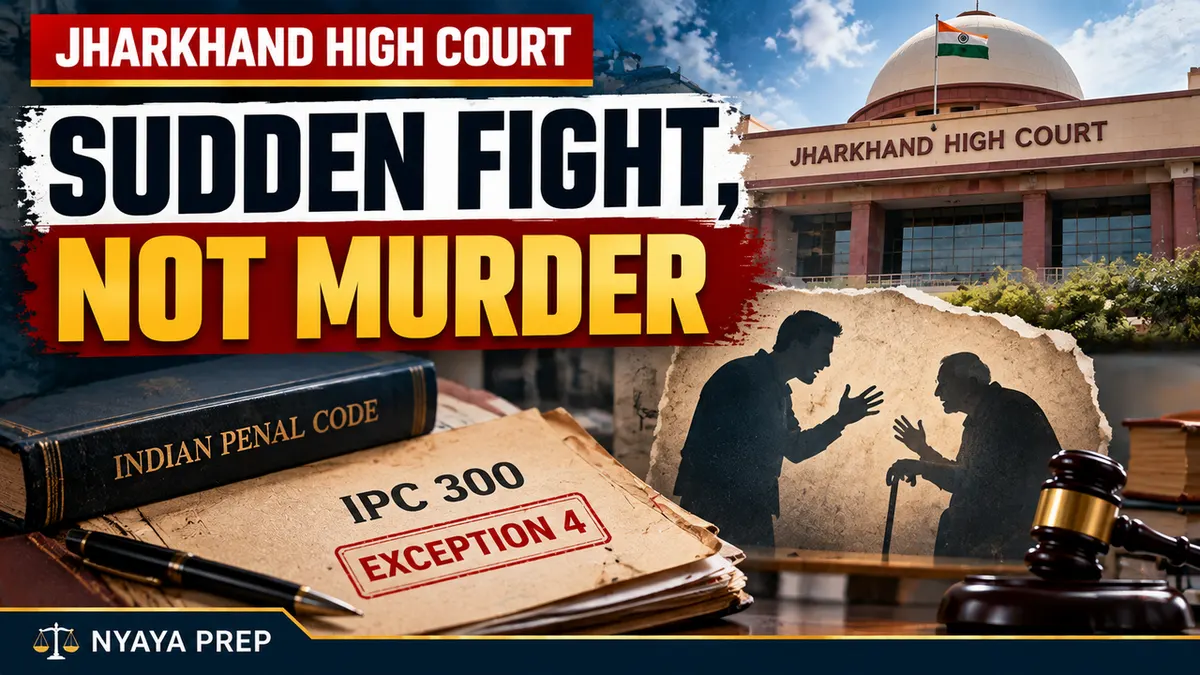
Conviction altered on appeal
The Jharkhand High Court converted an elderly man’s murder conviction into culpable homicide not amounting to murder after examining a fatal stabbing that followed a sudden quarrel between a father and son. A Division Bench of Justices Ananda Sen and Pradeep Kumar Srivastava applied Exception 4 to Section 300 of the Indian Penal Code and substituted a conviction under Section 304 Part II for the earlier conviction under Section 302. The judgment was delivered on 24 September 2026 and was reported on 27 October. The Court reduced the sentence to the period already undergone, taking account of the circumstances and the appellant’s advanced age. The decision does not establish a universal rule that every single knife injury falls outside murder.
The incident and trial findings
The prosecution case arose from an incident on 21 November 2013 at a residence in West Singhbhum. According to the account recorded from the appellant’s wife, Goma Gope was drinking hariya, a local alcoholic drink, when his son Pratap Gope returned and questioned his drinking. An argument followed. During the confrontation, the father picked up a vegetable-cutting knife and stabbed his son in the abdomen. The son died at the scene. An FIR was registered the next day and the case went to trial. In August 2018, the Sessions Court convicted the father of murder and sentenced him to life imprisonment with a fine of ₹5,000. He challenged the conviction in appeal.
Evidence examined by the appellate court
The High Court reviewed the testimony of the prosecution witnesses, the medical evidence and the surrounding circumstances. The appellant’s wife was the principal eyewitness to the incident; other witnesses described matters learned later or steps taken during investigation. The prosecution relied on recovery of a knife and blood-stained soil and maintained that the murder conviction was justified. The defence disputed the conclusion of murder and pointed to the prolonged incarceration. Medical evidence supported the conclusion that a single knife blow had been delivered. The bench considered the setting of the quarrel, its immediate escalation and the absence of evidence suggesting advance planning to kill the son.
How Exception 4 to Section 300 operated
Exception 4 addresses culpable homicide committed without premeditation in a sudden fight, in the heat of passion upon a sudden quarrel, where the offender has not taken undue advantage or acted in a cruel or unusual manner. Those elements must be assessed together against the evidence. The number of injuries may be relevant but cannot by itself decide the legal classification. Here the bench found that the confrontation arose spontaneously over drinking and that the fatal act occurred on the spur of the moment. It was not persuaded that the circumstances established the premeditated intention required for the murder conviction as framed. The court therefore brought the conduct within the lesser category.
Sentence and significance for criminal law
The bench converted the conviction to Section 304 Part II, which concerns culpable homicide committed with the requisite knowledge but without the intention associated with Part I. It then considered the appellant’s age, approximately 88 at the time of appeal, the duration of proceedings and the period spent in custody. The sentence was reduced to time already served. For law students, the ruling illustrates the distinction between intention and knowledge, and the importance of the statutory exceptions to murder. It is especially important not to convert the phrase single blow into a mechanical legal test. A single injury may still amount to murder where the proven circumstances and mental element support that conclusion.
What the ruling does and does not say
The appellate decision concerns a prosecution governed by the IPC because the incident occurred in 2013. The Bharatiya Nyaya Sanhita now contains the contemporary framework for homicide offences, but the historical statutory references in this case should not be silently replaced with BNS section numbers. The Court did not disbelieve that the appellant caused the fatal injury; it changed the legal character of the offence and the punishment. The outcome was a partial success for the appeal, not a complete acquittal. The judgment underlines why courts must separately evaluate the act, the surrounding provocation, the mental element and the conditions of the applicable exception.
Case Details
Case name: Goma Gope @ Goma v. State of Jharkhand
Citation: 2026:JHHC:28803-DB
Court: Jharkhand High Court
Bench: Justices Ananda Sen and Pradeep Kumar Srivastava
Case number: Criminal Appeal (D.B.) No. 1400 of 2018
Relevant Bare Act
Act: Indian Penal Code, 1860
Relevant provisions: 300 Exception 4; 304 Part II; 302
- Jharkhand High Court
- IPC Section 300 Exception 4
- IPC Section 304 Part II
- IPC Section 302
- BNS
- Culpable Homicide