High Court Judgments
Jammu and Kashmir High Court Strikes Down Water Usage Levy on Hydropower Generation
Nyaya Prep • Published • Updated • 4 min read
The constitutional ruling
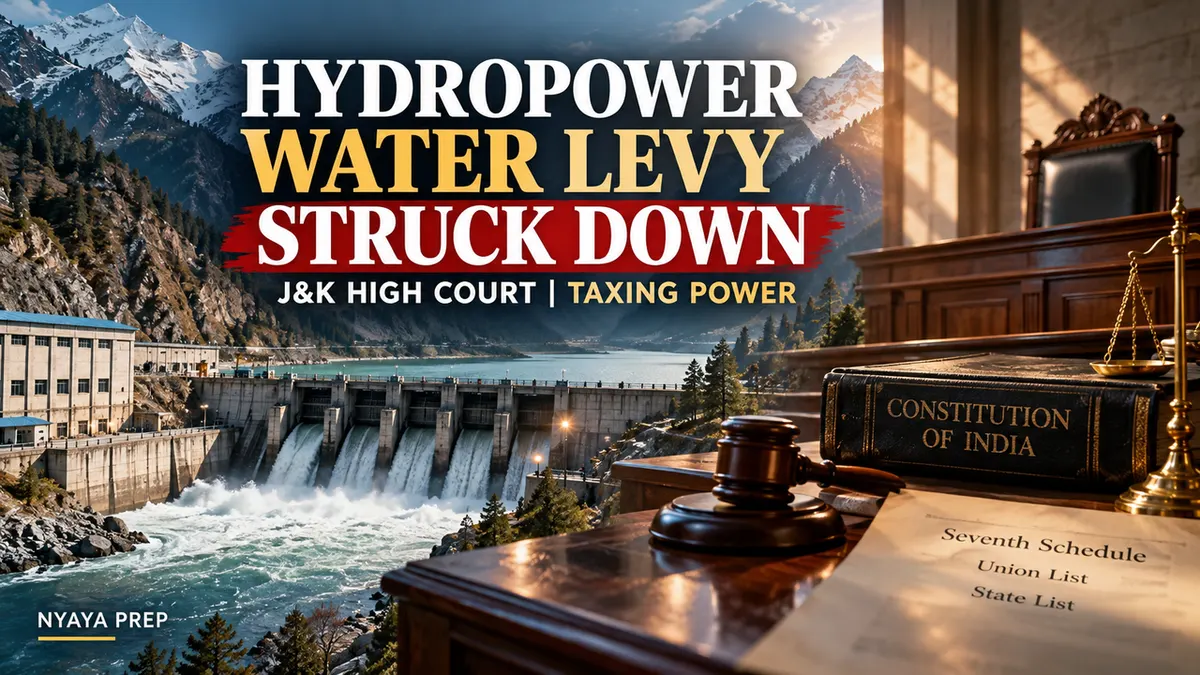
A division bench of Justices Rajnesh Oswal and Sanjay Dhar allowed challenges by independent hydropower producers to the water usage charges imposed under the Jammu and Kashmir Water Resources (Regulation and Management) Act, 2010, and associated rules. The Court held that the levy, although described as a charge for water use, was in substance a tax on electricity generation. The erstwhile State Legislature lacked competence to impose such a tax under the relevant constitutional distribution of taxing powers.
The bench struck down the legislation only to the extent it authorised the impugned charge on hydroelectric projects and quashed the associated demand notices. It also restrained the authorities from levying a tax on electricity generation under the label of water usage charges. The decision does not invalidate every provision of the 2010 Act or prohibit all regulatory charges connected with water management. Its operative reach follows the particular levy and constitutional defect examined in the three connected petitions.
How the dispute developed
The petitions were brought by independent power producers operating river-based hydroelectric projects. They challenged demands issued under the 2010 legislation and the rules framed in 2011. The projects use flowing water to generate electricity, and the petitioners contended that the charge was linked to generation rather than actual consumption of water. The record also referred to their obligations to supply free electricity to the government under project arrangements, although the constitutional competence question was central to the Court’s decision.
The government defended the measure as regulation of water resources under Entry 17 of the State List. It also argued that the law’s continued application after the Jammu and Kashmir Reorganisation Act, 2019 supported its validity. The Union’s position, recorded in the judgment, was that States could not impose a tax on electricity generation merely by describing it as a water charge. The Court examined the nature and destination of the levy rather than relying on its statutory label.
Fee or tax: why the distinction mattered
The bench observed that money collected under Section 185-A was directed towards purposes including hydel development, acquisition of projects, transmission investment and purchase of power, rather than services supplied to the particular licensees. It found no relevant quid pro quo supporting the characterisation of the levy as a fee. In substance, the payment was tied to the use of water as an indispensable step in generating electricity, making the taxable event generation itself.
Entry 53 of List II permits State taxation of electricity consumption or sale, but not generation. The Court rejected attempts to locate the impugned generation tax within broader water-regulation powers. It also rejected the contention that the continuation or adaptation of the law after reorganisation retrospectively cured an original want of legislative competence. A law invalid when enacted does not become constitutionally sound merely through administrative continuation.
Consequences for projects and the administration
The judgment, pronounced on 29 October and reported on 31 October, directly affects the demands issued against the petitioning producers. It clarifies that a public authority must justify a financial exaction by its true legal character and a valid source of legislative power. The ruling is relevant to electricity and infrastructure regulation because a charge described as a service fee may still be treated as a tax if its structure and purpose disclose a different substance.
Further administrative or appellate steps, if any, were not established in the materials reviewed. The immediate operative position is that the impugned generation-linked demands cannot stand under the invalidated portion of the law. The judgment is particularly significant for the relationship between water regulation, power generation and the Seventh Schedule, but its reasoning should be applied to other levies only after examining their own statutory design.
Case Details
Case: M/s Mass N Energy and Others v Union of India and Others, WP(C) 3008/2024 with WP(C) 3324/2025 and 3329/2025
Bench: Justices Rajnesh Oswal and Sanjay Dhar
Advocates: Shariq J. Reyaz, Humaira Sajad, Pranav Kohli, Raunak Gupta and others for petitioners; A.R. Malik and T.M. Shamsi among respondents’ counsel
Relevant Bare Act
Jammu and Kashmir Water Resources (Regulation and Management) Act, 2010: Sections 120, 128, 130 and 185-A (issues considered)
Constitution of India: Seventh Schedule, List II Entries 17 and 53
- Jammu Kashmir High Court
- Hydropower
- Taxation
- Legislative Competence
- Water Resources