HC
Himachal Pradesh High Court Denies Anticipatory Bail, Holds Engagement Cannot Substitute for Consent
Nyaya Prep • Published • Updated • 4 min read
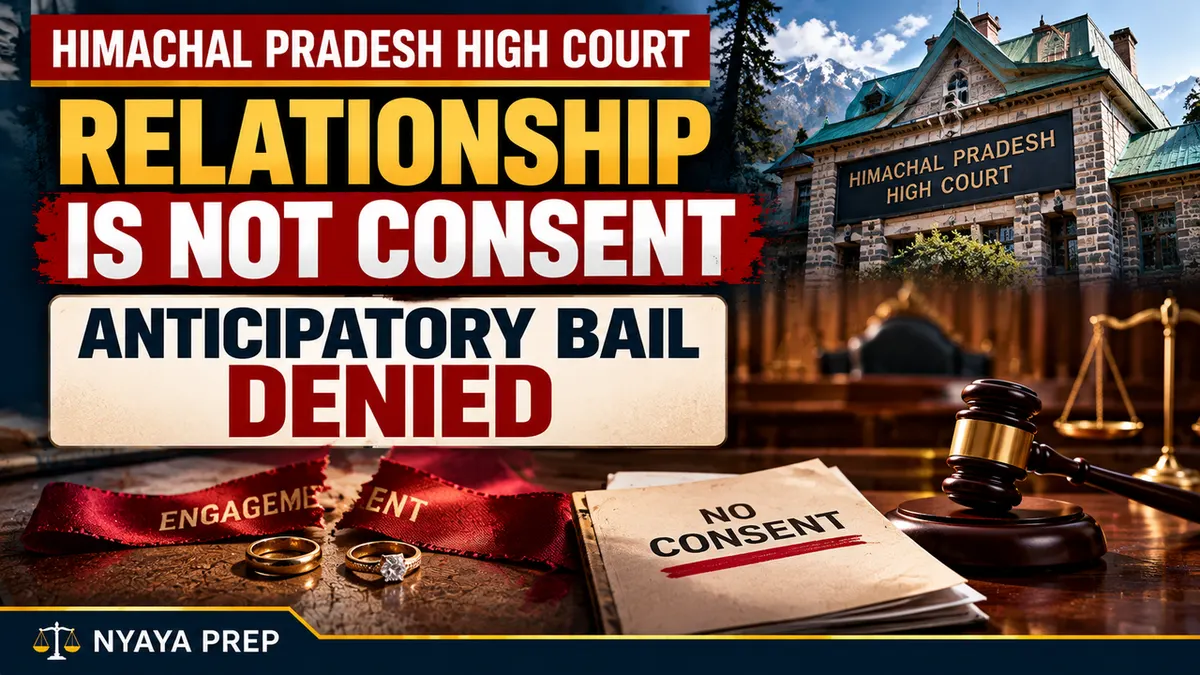
Anticipatory bail refused
The Himachal Pradesh High Court rejected an application for anticipatory bail filed by a man accused of sexually assaulting and physically injuring his fiancée. Justice Chirag Bhanu Singh stressed that a long relationship or engagement does not amount to consent to every sexual act. The order in Tarun Bharota v. State of Himachal Pradesh and Another was decided on 12 October 2026 and reported on 27 October. The applicant had sought protection under Section 482 of the Bharatiya Nagarik Suraksha Sanhita in an FIR alleging offences under Sections 64(1), 115(2) and 351(2) of the Bharatiya Nyaya Sanhita. The Court’s conclusions were made at the bail stage and do not amount to a final determination of guilt.
Allegations recorded in the complaint
The complainant and the applicant had been in a relationship for several years and were engaged. The FIR registered at Manali Police Station in August 2026 concerned allegations that the applicant assaulted her, forced sexual acts against her will, caused burn injuries and intimidated her. These allegations are serious, but they remain accusations to be tested in the criminal process. The prosecution and complainant relied on medical material and other circumstances to oppose pre-arrest bail. The defence denied the allegations and maintained that the relationship, delay in the complaint and disputed interpretation of the medical record weighed in favour of bail. The Court considered those submissions without conducting a full criminal trial.
The applicant’s case for protection
The applicant argued that the parties had been in a long-standing relationship and that he was being falsely implicated after their personal differences. Counsel referred to the timing of the complaint and disputed whether the medical record corroborated the allegations. The applicant also submitted that he was not a flight risk, was the sole earning member of his family and that custodial detention would not advance the investigation. These were arguments advanced for interim protection, not factual findings accepted by the Court. The complainant’s counsel contested them and alleged continued pressure on the complainant and witnesses even after interim protection had been granted. The bench had to assess whether discretionary pre-arrest bail was justified in light of the material available.
Consent and medical material
The High Court considered the medical evidence and the complainant’s account together. It found that the allegations were prima facie supported by recorded injuries and that the claimed relationship did not neutralise the complainant’s assertion that particular acts were against her will. Consent must relate to the act in question; it cannot be presumed from engagement, cohabitation or past intimacy. The Court also treated the alleged attempts to influence witnesses as relevant to the bail assessment. The decision is important because it avoids a common error in sexual-offence litigation: treating relationship status as a substitute for examining whether free and voluntary agreement existed at the relevant time.
Bail principles and safeguards
Anticipatory bail is a discretionary safeguard against arrest, not an automatic entitlement. Courts weigh the nature of allegations, available evidence, investigation requirements, risk of flight, possible witness interference and the interests of justice. Refusal of pre-arrest bail does not reverse the presumption of innocence. Equally, a person accused of a grave offence cannot obtain anticipatory bail solely by asserting a pre-existing romantic relationship. The High Court considered the circumstances at this procedural stage and declined to extend protection. For judiciary-examination candidates, it is useful to distinguish the legal test for granting bail from the much higher standard of proof required for conviction after a trial.
What happens next
The applicant’s request for anticipatory bail was dismissed. The criminal investigation and any later proceedings must continue under the applicable BNS and BNSS provisions, with the accused retaining all procedural protections and the prosecution bearing the burden of proving the charges. The order should not be described as a conviction or as a final finding that every allegation occurred. Its broader significance is the Court’s insistence that consent is specific and that the existence of a relationship cannot pre-empt scrutiny of allegations of force, injury or intimidation. The case also shows why medical material and witness-protection concerns can matter when courts decide pre-arrest bail.
Case Details
Case name: Tarun Bharota v. State of Himachal Pradesh and Another
Citation: 2026:HHC:44713
Court: Himachal Pradesh High Court
Bench: Justice Chirag Bhanu Singh
Case number: Cr.MP(M) No. 1774 of 2026
Relevant Bare Act
Act: Bharatiya Nagarik Suraksha Sanhita, 2023; Bharatiya Nyaya Sanhita, 2023
Relevant provisions: BNSS 482; BNS 64(1); BNS 115(2); BNS 351(2)
- Himachal Pradesh High Court
- Consent
- Sexual Assault
- Anticipatory Bail
- BNSS 482
- BNS 64(1)
- BNS 115(2)
- BNS 351(2)