High Court Judgments
Gujarat High Court Quashes Suicide-Abetment FIR Against Two Senior Doctors, Citing Lack of Intentional Instigation
Nyaya Prep • Published • Updated • 4 min read
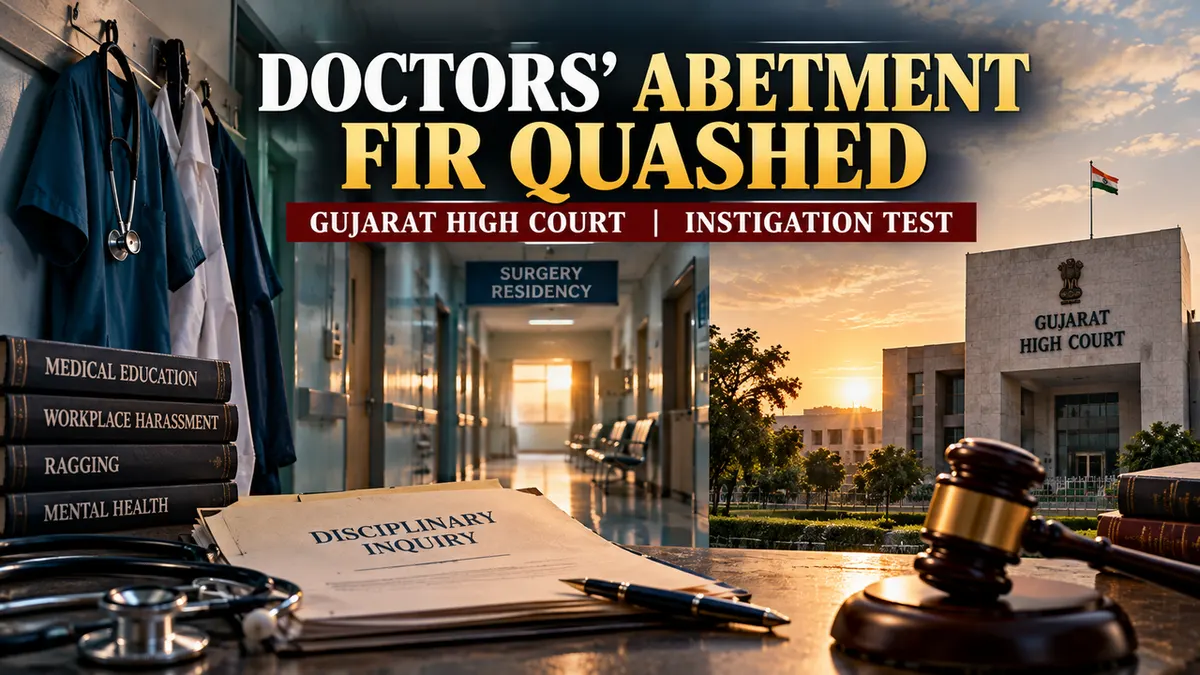
Court distinguishes strict supervision from criminal instigation
Justice P.M. Raval allowed the doctors’ challenge to a prosecution arising from the death of a 24-year-old first-year Master of Surgery resident. The Court held that ordinary departmental instructions, academic reprimands and allocation of ward work, even in a demanding residency environment, could not by themselves be treated as instigation under Section 107 of the Indian Penal Code. It found no sufficiently direct, positive act intended to drive the resident to suicide. Consequently, the FIR against the two petitioners was quashed.
The judgment did not endorse ragging or excuse workplace abuse. It expressly recognised that ragging is a serious social wrong capable of attracting appropriate legal and administrative action. Its narrower criminal-law conclusion was that a prosecution under Section 306 IPC requires proof of the statutory ingredients of abetment. Unpleasant working conditions or even misconduct cannot automatically substitute for a demonstrated intentional connection between an accused person’s conduct and the decision to end one’s life.
A tragic residency and disputed allegations
The deceased had been enrolled in a surgical residency at Surat Civil Hospital for approximately 43 days before his death. The FIR and subsequent statements attributed distress to his work environment and interactions with seniors. The Court examined statements attributed to his father, including changes in the account from harassment to suspicion that the deceased had been killed. It considered forensic and medical findings concerning suicide and noted that the prosecution narrative had shifted in ways material to the alleged offence.
The Court also considered accounts of similar stress during the deceased’s earlier experience at another hospital. A telephone conversation with his father indicated dissatisfaction with the programme and a possible desire to leave, but the Court found no contemporaneous threat or positive act by the two petitioners establishing the necessary link to suicide. The fact that the deceased faced distress was not disputed as a human tragedy; what remained legally decisive was the evidentiary basis for attributing criminal abetment to these accused.
How Section 107 and Section 306 operate
Section 306 IPC punishes abetment of suicide, while Section 107 explains forms of abetment, including instigation and intentional aiding. The High Court stressed that the offence cannot be made out merely because a person dies by suicide after difficult interactions at work. The material must support the required mental element and conduct connected to the act. The Court assessed the brief duration of the residency, the nature of the alleged instructions and the absence of independently corroborated threats or abuse by the petitioners.
The Court also referred to the investigation’s treatment of other senior institutional officials, against whom charges had not been pursued. It considered that circumstance when evaluating the consistency of the broader allegation of collective harassment. The ruling should not be generalised to mean that sustained coercion or targeted humiliation can never amount to abetment. It is a fact-specific conclusion about the evidence and statutory ingredients in this particular FIR.
Implications for medical institutions and investigations
The decision underscores two separate duties. Investigators must distinguish actionable criminal instigation from unsupported assumptions, especially when the allegation concerns a grave offence. Medical institutions, meanwhile, remain responsible for addressing ragging, intimidation and unsafe training conditions through appropriate safeguards. The absence of proof for Section 306 against particular individuals does not settle every question about workplace welfare or institutional accountability.
The immediate result is termination of the challenged criminal proceedings against the two doctors. The Court did not determine a general immunity for senior residents or pronounce that every complaint of harassment was false. Future cases will depend on their own evidence, including contemporaneous communications, direct threats, sustained conduct and the required mental element. For legal practitioners, the case illustrates why the language of an FIR must be tested against the specific elements of the charged offence.
Case Details
Citation: 2026 LiveLaw (Guj) 301 (reporter citation)
Bench: Justice P.M. Raval
Relevant Bare Act
Indian Penal Code, 1860: Sections 107 and 306
- Gujarat High Court
- Abetment of Suicide
- Medical Residency
- IPC
- Criminal Law