HC
Gujarat High Court Quashes Corruption Case After Finding Cash Recovery Alone Insufficient
Nyaya Prep • Published • Updated • 4 min read
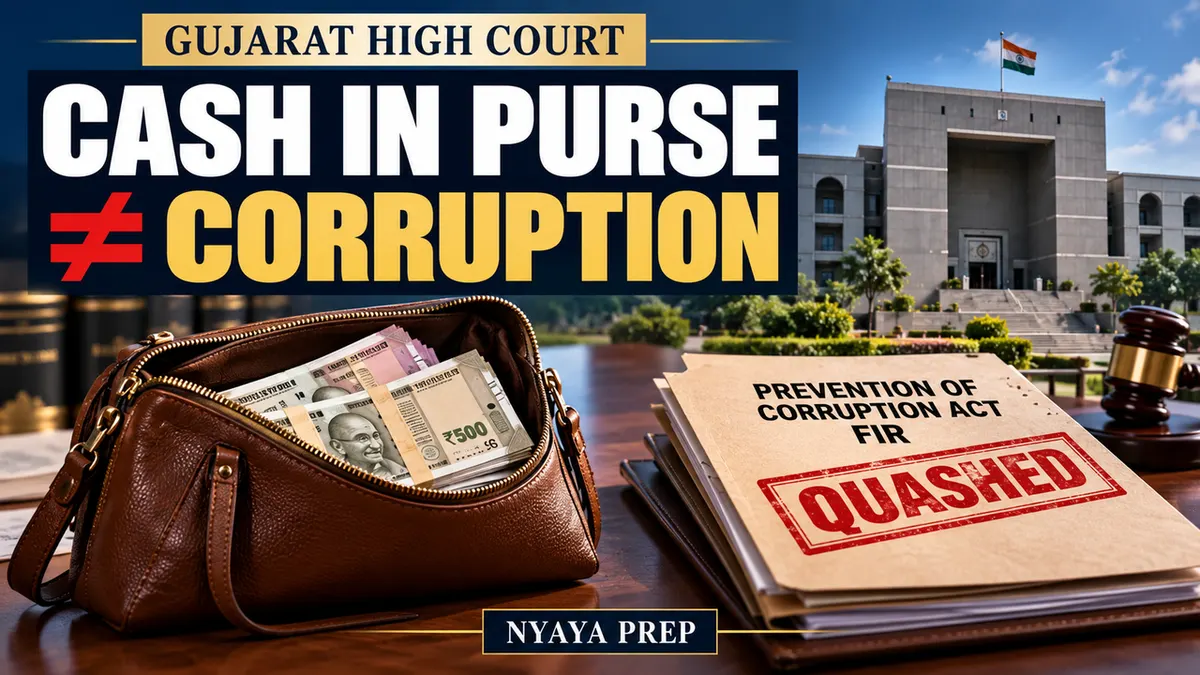
A raid and the disputed cash
Justice P.M. Raval decided Dipikaben Rohitkumar Chauhan v State of Gujarat in Criminal Miscellaneous Application No. 19978 of 2014 by judgment dated 21 October 2026. The applicant, a public servant, challenged proceedings arising from a search conducted after anonymous complaints. Investigators recovered ₹45,420 from her purse. The prosecution sought to treat the cash and the initial explanation offered for it as the basis for criminal misconduct allegations.
The case required the Court to examine whether the materials in the FIR and charge-sheet disclosed the ingredients of offences under the pre-amendment provisions of Section 13(1)(d) or 13(1)(e) of the Prevention of Corruption Act, 1988. The question was not whether the cash was found; possession was accepted for purposes of examining the prosecution case. The dispute concerned the legal consequences that could properly follow from that fact.
Why the corruption allegation failed
For Section 13(1)(d), the Court looked for material showing that the employee obtained a valuable thing or pecuniary advantage through corrupt or illegal means or by abusing her public position. It found no statement or evidence identifying such a mechanism. The recovery did not arise from a trap in which a tainted bribe amount was allegedly accepted. A suspicious circumstance, without the statutory link to corrupt acquisition, could not by itself sustain the charge.
The Court separately considered the disproportionate-assets allegation under Section 13(1)(e). That offence required an assessment of the nature and extent of the property, the known sources of income and the alleged disproportion. The prosecution had not demonstrated the necessary comparison. The Court noted salary materials relating to the applicant and her husband, both government employees, while examining whether the amount could reasonably be treated as unexplained wealth.
Evidence and competing submissions
The State argued that the applicant had given inconsistent explanations for the money and had not satisfactorily accounted for it when questioned. The defence referred to the amount in relation to earnings and also relied on communications showing that separate disproportionate-assets complaints had been closed. The judgment treated these matters as part of the evidentiary record, without making a universal rule that every later explanation must be accepted.
What proved decisive was the failure of the prosecution materials to establish the ingredients of the offences charged. The Court explained that a person fumbling when asked about cash does not automatically prove possession of resources disproportionate to known income. It also distinguished the applicant’s position from a person caught receiving a demonstrated illegal payment.
Statutory distinction matters
Criminal misconduct under the Prevention of Corruption Act is defined through specific statutory requirements. The pre-2018 text of Section 13 governed the allegations in this older prosecution. The current Act has since been amended, so the judgment should not be described as an interpretation of every element of the Act’s present version.
The decision illustrates why investigators must gather evidence about the origin of money, the alleged abuse of office and the comparison between assets and known income. Courts do not infer the existence of each statutory ingredient merely because a public servant possesses cash or initially provides an imperfect explanation. At the same time, the ruling does not immunise genuinely corrupt receipts or unexplained assets supported by proper evidence.
Effect of the decision
The High Court granted the quashing relief in the proceedings before it. The operative effect is case-specific: the FIR and charge-sheet materials were found insufficient to sustain the corruption prosecution as framed. It is not a general declaration that cash discovered during searches is irrelevant or that public servants are exempt from financial scrutiny.
For anti-corruption investigations, the ruling reinforces the distinction between suspicion and proof of the legal ingredients necessary to proceed. For public employees, it demonstrates the importance of assessing the precise charge and the available evidence rather than treating every unexplained transaction as automatically constituting criminal misconduct.
The Court's scrutiny of the prosecution papers is especially relevant to the distinction between an allegation under Section 13(1)(d) and a disproportionate-assets theory under Section 13(1)(e). Each route requires its own facts and evidence. The judgment does not convert a defence explanation into a conclusive presumption; rather, it finds the prosecution material itself lacked the necessary foundation for the offences invoked.
- Gujarat High Court
- Prevention of Corruption Act
- Criminal Misconduct
- Disproportionate Assets