High Court Judgments
Gujarat High Court Division Bench Stays Order Lifting Somnath Non-Vegetarian Food Ban
Nyaya Prep • Published • 4 min read
What the division bench ordered
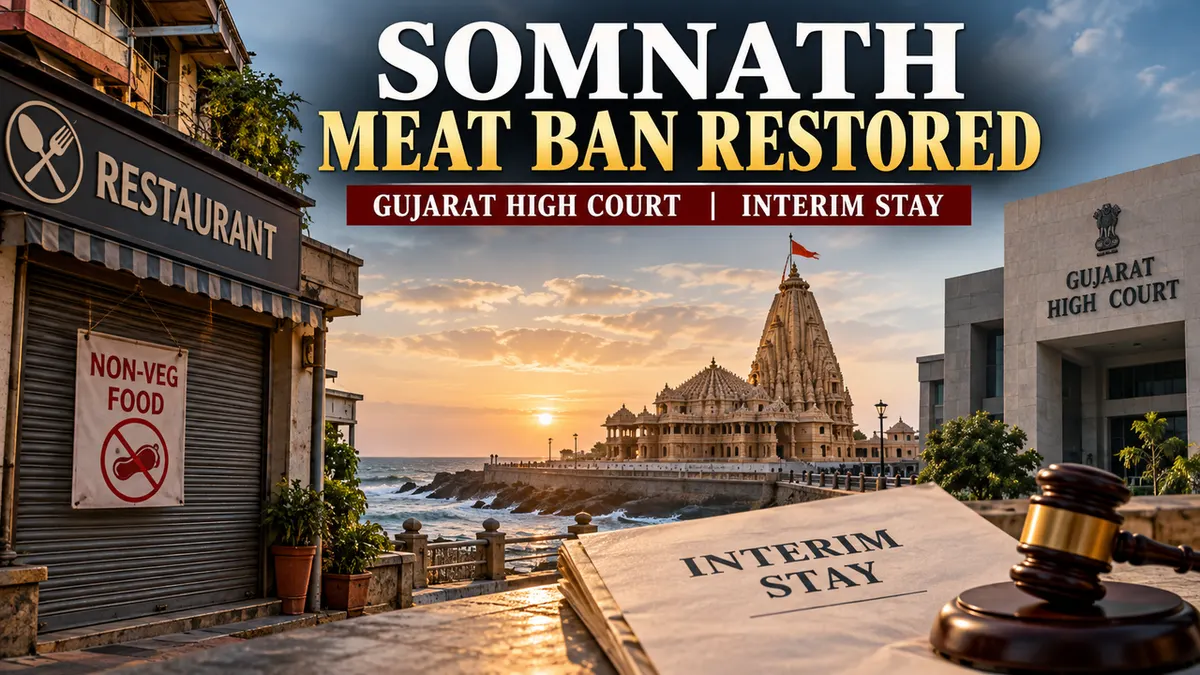
Acting Chief Justice Manash Ranjan Pathak and Justice Nirzar S. Desai heard the State’s urgent Letters Patent Appeal on 30 October 2026, the same afternoon that a single judge had allowed restaurant owners’ challenge. The division bench assembled at approximately 5:30 PM after the State sought immediate circulation. It issued notice returnable on 25 November and stayed the single-judge judgment until further orders. The practical consequence is that the district magistrate’s existing restrictions continue to operate while the appeal remains pending.
This is an interim appellate order, not a final decision that the food restrictions are constitutionally valid. The bench recorded the arguments, considered the approaching Deepavali and Gujarati New Year period, and preserved the notification pending further consideration. It also directed service on a respondent and listed the appeal alongside an older petition involving some of the same restaurant owners. The merits of the State’s statutory power and the restaurant owners’ fundamental-rights objections therefore remain live questions.
How the dispute arose
The Gir-Somnath District Magistrate issued a preliminary notification on 10 July 2026 inviting objections and a final notification on 10 August under Section 33(1)(w) of the Gujarat Police Act, 1951. It restricted preparation, storage and sale of meat, fish and other non-vegetarian dishes along specified public routes and within 500 metres of Somnath Temple. Restaurant owners challenged the measure in Special Civil Application 13977 of 2026, arguing that a regulatory power over public entertainment and order did not authorise a permanent prohibition on their lawful business.
Justice Nisha M. Thakore accepted the challenge at first instance on 30 October. The single judge considered the restriction disproportionate, questioned whether religious sentiments alone justified a sweeping trade prohibition, and examined the scope of the Police Act after statutory changes affecting eating houses. The State immediately appealed. The appellate bench did not finally endorse or reject the single judge’s detailed analysis; its immediate task was whether that decision should operate during the appeal.
Arguments and legal questions
Advocate General Kamal Trivedi submitted that reasonable restrictions were permissible and cited earlier decisions. He also pointed to the expected influx of devotees during the festival period, arguing that the sale and consumption of non-vegetarian food in the notified locations could cause inconvenience, annoyance or public-order concerns. The restaurant owners, represented by Asarar L. Mansuri, disputed the applicability of Section 33(1)(w), saying it addressed places of public amusement or entertainment rather than prescribing what food a restaurant may serve.
The central legal issue is the difference between regulating an activity and prohibiting it altogether. The competing constitutional considerations include freedom to carry on trade under Article 19(1)(g), the State’s asserted public-order concerns, and the proper limits of delegated regulatory authority. The appellate order should not be read as a definitive holding that one interest invariably prevails. A later hearing will determine the legal consequences after the parties address the underlying merits.
Immediate effect and next hearing
The division bench’s signed order identifies the appeal as Letters Patent Appeal 886 of 2026 and records that the August notification remains in force until the returnable date, with the single-judge order stayed until further orders. It does not impose new criminal penalties, decide individual licensing disputes or resolve the entire constitutional challenge. Businesses within the notified areas must distinguish this temporary operative position from the final result that may emerge after the State’s appeal is heard.
The case is listed for 25 November 2026. Its significance extends beyond the particular temple precinct because the final adjudication may clarify when a statutory power to regulate public places can support broad restrictions on lawful commercial activity. For now, the verifiable new development is the stay and continuation of the notification, not a final validation of every part of the ban.
Case Details
Case: State of Gujarat & Others v M/s Taj Restaurant Owner Aakib Aminbhai Khan & Others, LPA 886/2026
Citation: GJHC240846182026; order dated 30 October 2026
Bench: Acting CJ Manash Ranjan Pathak and Justice Nirzar S. Desai
Advocates: Kamal Trivedi, G.H. Virk, Dharitri Pancholi, Brijensingh Thakur for State; Asarar L. Mansuri for respondents
Relevant Bare Act
Gujarat Police Act, 1951: Section 33(1)(w)
Constitution of India: Articles 19(1)(g), 25
- Gujarat High Court
- Somnath Temple
- Gujarat Police Act
- Interim Stay
- Trade Freedom