SC
Election Commission Defends Unanimous SIR Decisions, Clarifies Form 6 and West Bengal Voter Appeals
Nyaya Prep • Published • 5 min read
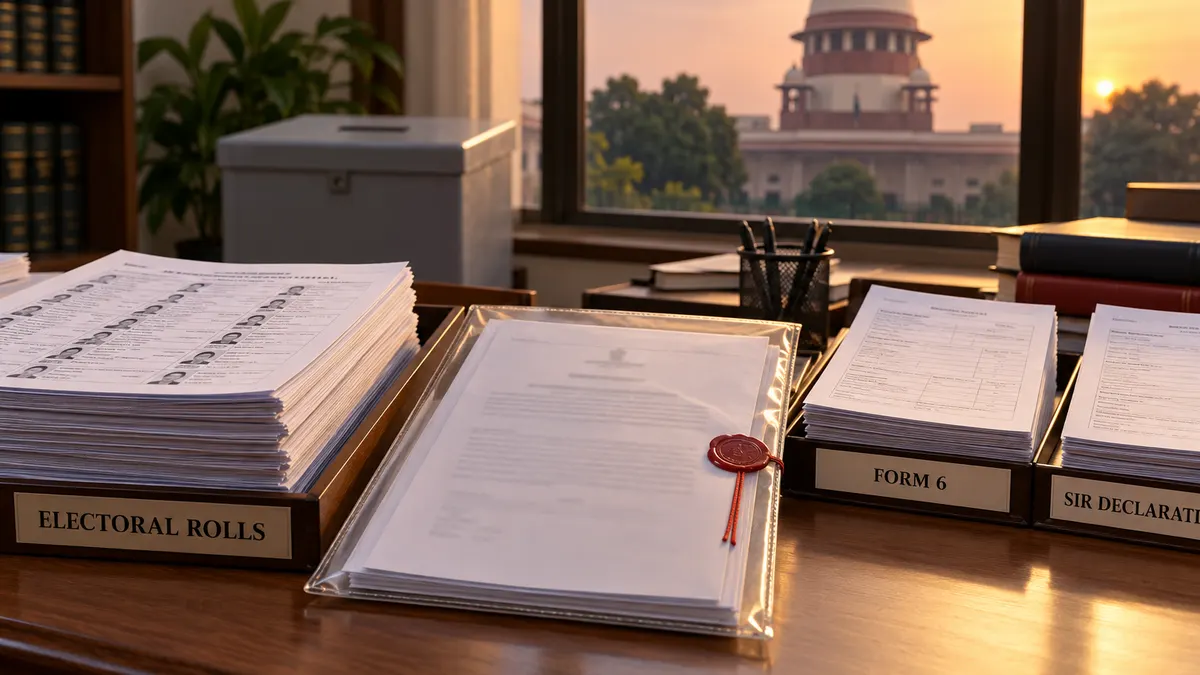
The Election Commission of India (ECI) has filed a counter-affidavit before the Supreme Court asserting that its principal decisions on the Special Intensive Revision (SIR) of electoral rolls were taken unanimously and that the Commission did not amend the statutory voter-registration Form 6. The filing responds to proceedings questioning the Chief Election Commissioner’s exercise of authority and the legal basis of decisions taken during the revision process.
Background and the legal dispute
The response follows a petition by Rakesh Kumar Singh alleging that Chief Election Commissioner Gyanesh Kumar exercised collective powers without the necessary agreement of Election Commissioners Sukhbir Singh Sandhu and Vivek Joshi. The challenge referred to reported objections in internal files and questioned whether decisions affecting electoral rolls had been taken in the manner required by law.
The Supreme Court had issued notice in the matter on 5 October 2026 but declined to suspend the Chief Election Commissioner through an ex parte interim order. The Court indicated that the legality of the disputed decisions would be examined. The Commission’s latest affidavit places its response to those allegations on record ahead of further consideration.
What the Commission says about collective decisions
The ECI maintains that three significant SIR orders, dated 24 June 2025, 27 October 2025 and 14 May 2026, were unanimous decisions. It also states that the counter-affidavit itself received the approval of all three members of the Commission. The Commission disputes the suggestion that a query, note or objection recorded while a file is moving through the institution necessarily represents a final dissent from a decision.
Section 18 of the Chief Election Commissioner and Other Election Commissioners (Appointment, Conditions of Service and Term of Office) Act, 2023 provides the framework for collective decision-making. The Commission’s position is that decisions should, as far as practicable, be unanimous and otherwise be determined by majority. It says files ordinarily move between the Election Commissioners and then to the Chief Election Commissioner, with electronic approvals used in urgent matters and recorded subsequently.
The affidavit further contests the petition’s maintainability, arguing that its allegations rest substantially on a newspaper report rather than independently verified material. The ECI says it did not authorise disclosure of internal files to the press. Whether those objections dispose of the petition remains a matter for the Court.
Form 6 and the additional SIR declaration
A central issue concerns Form 6, the prescribed form used by persons seeking inclusion in electoral rolls. The Commission says it has not changed that form and that any amendment to the form prescribed under the Registration of Electors Rules, 1960 would require action by the competent rule-making authority. According to the ECI, the declaration seeking details connecting applicants or their families with earlier rolls is a separate SIR document.
The Commission acknowledges that the way the two documents appeared in the online application process could create an impression that Form 6 itself had been altered. It says the interface was designed to permit a single authentication step, but a decision taken on 21 October 2026 provided for the online process to display Form 6 and the SIR declaration separately, reflecting the physical application arrangement.
Safeguards for applicants and electoral records
The affidavit describes steps intended to reduce unnecessary personal appearances by applicants whose names cannot be mapped to earlier electoral rolls. The ECI says Booth Level Officers should ordinarily collect relevant documents at applicants’ homes and upload them for consideration by the Electoral Registration Officer. Hearings should be reserved for exceptional cases and, where feasible, conducted online.
It also states that entries cannot be added to, deleted from or modified in electoral rolls through the ECINet platform without an order of the competent Electoral Registration Officer. The Commission says a committee including external technical experts has been constituted to examine the platform’s functioning and compliance. These administrative explanations are relevant to the Court’s assessment of whether statutory authority and procedural safeguards have been respected.
West Bengal voter inclusion appeals
In a related part of the same affidavit, the ECI says appeals challenging the inclusion of certain voters in West Bengal were filed by officers of the State Chief Electoral Officer’s office in their statutory capacities. According to the Commission, those appeals were not placed before the Commission itself. It relies on communication from the State office and earlier Supreme Court directions concerning electoral-roll appellate mechanisms.
The ECI says the affected voters were already on the rolls, had obtained favourable orders from adjudicatory authorities and were entitled to vote in the recent Assembly elections. The available reporting does not establish the precise number of appeals authorised by each officer or the grounds of every appeal. The distinction matters because an appeal filed by a statutory State election officer is not necessarily the same as a decision taken collectively by the three-member Commission.
What happens next
The ECI has also disputed the request to restrain the Chief Election Commissioner from functioning, referring to the constitutional protection governing removal from that office. It has reserved the right to submit a fuller paragraph-wise response. The Supreme Court is expected to consider the affidavit in the pending petitions; no final ruling on the validity of the SIR decisions, the additional declaration or the disputed internal decision-making has been reported in this development.
The immediate consequence is therefore procedural rather than dispositive: the Commission’s explanations are now before the Court, and the petitioners may contest them in the continuing proceedings. The legal questions concerning collective authority, voter-registration documentation and safeguards in the revision exercise remain open for judicial determination.
Case: Rakesh Kumar Singh v. Union of India and connected proceedings. Proceedings: W.P.(C) No. 1246/2026 and W.P.(Crl.) No. 401/2026, as reported.
- Election Commission
- Special Intensive Revision
- Form 6
- Electoral Rolls
- Supreme Court