HC
Delhi High Court Upholds Seven-Year Sentences in 2020 Riots Culpable Homicide Case
Nyaya Prep • Published • Updated • 4 min read
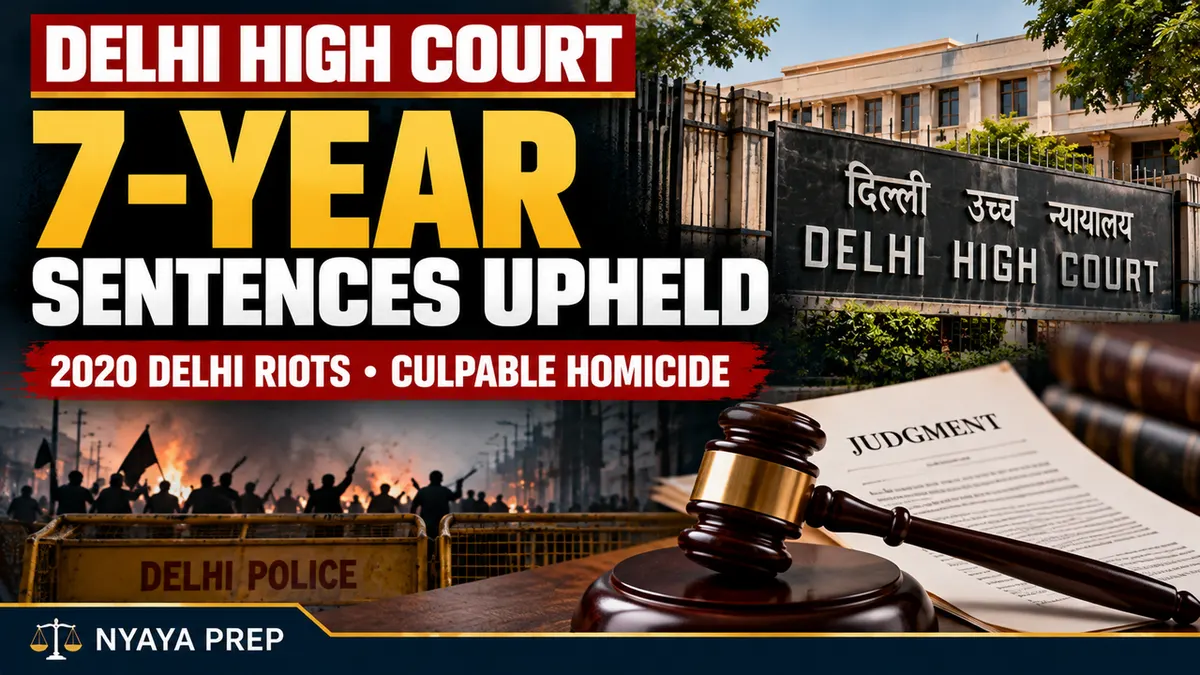
Five criminal appeals dismissed
The Delhi High Court dismissed five connected appeals and upheld convictions arising from the death of a young man during the February 2020 violence in North-East Delhi. Justice Madhu Jain affirmed the trial court’s findings under Sections 148 and 304 Part I read with Section 149 of the Indian Penal Code. The appellants were Aman Kashyap, Devinder Kumar, Pradeep Rai, Ashish alias Goli and Arun Kumar. The trial court had imposed one year of simple imprisonment for rioting while armed with a deadly weapon and seven years of rigorous imprisonment with a fine of ₹30,000 for culpable homicide, with substantive terms running concurrently. The High Court pronounced its judgment on 27 October 2026.
Incident and procedural history
According to the prosecution case accepted by the trial court, a mob pursued and assaulted 22-year-old Monish near Peer Baba Mazar, Chand Bagh, on 25 February 2020. He was taken to Guru Teg Bahadur Hospital and died from injuries later attributed by medical examination to blunt-force trauma to the brain. The police investigated the incident under FIR No. 87/2020 at Dayalpur Police Station. The Additional Sessions Judge convicted the five accused in November 2024 and imposed sentence in January 2025. They challenged both the assessment of the evidence and the application of group liability under the IPC. The High Court heard the appeals together because they arose from the same trial judgment.
Defence objections and prosecution case
The appellants questioned the reliability of eyewitness accounts, the timing of police statements and the absence of a test identification parade. They also challenged whether the evidence proved their participation in the mob and the necessary common object. The prosecution relied on police witnesses who described the pursuit and assault, including a beat constable who stated that he already knew the appellants. The defence argued that shortcomings in identification and investigation created reasonable doubt. The High Court considered those objections against the full evidentiary record rather than treating every investigative imperfection as automatically fatal. The Court found the police witnesses’ accounts substantially consistent with relevant duty records and the medical evidence.
Unlawful assembly and constructive liability
Section 149 IPC can impose liability on members of an unlawful assembly for offences committed in prosecution of the common object, or offences the members knew were likely to be committed in pursuing that object. The High Court found more than accidental presence at the scene. It noted evidence that the appellants were at the forefront of an armed mob, exhorting others to attack the deceased, and that the victim was chased and assaulted even after falling near barricades. The Court concluded that the circumstances supported the requisite common object or knowledge. Once that foundation was established, the prosecution was not required to identify which particular member inflicted each fatal injury to sustain liability under the group-liability provision.
Treatment of police evidence
The judgment also addresses a familiar criminal-trial question: whether police officers can be reliable eyewitnesses. The High Court did not adopt a presumption that official witnesses must be believed, but rejected the opposite presumption that their testimony is inherently untrustworthy. Their accounts must be assessed on their own merits, including opportunity to observe, consistency and corroboration. Here the bench found support in duty records and in the broad correspondence between accounts of the chase, assault and rescue. For judiciary candidates, the case illustrates how courts evaluate identification objections, group liability and witness credibility in a violent crowd setting. The legal analysis remains tied to the particular evidence and does not establish guilt by association.
Outcome and statutory context
The five appeals were dismissed and the trial court’s conviction and sentence were maintained. The decision is a final appellate determination at the High Court level, subject to any further remedy available under law. Because the incident occurred in 2020, the operative charges were framed under the IPC. Modern BNS provisions should not be substituted into the historical judgment as though they were the sections actually applied. The ruling’s wider importance is the insistence that constructive criminal liability requires proof of membership and common object, but does not require an impossible reconstruction of every blow once those statutory elements and the resulting offence are established.
Case Details
Case name: Aman Kashyap v. State of NCT of Delhi and Connected Matters
Citation: CRL.A. 133/2025 and connected appeals
Court: Delhi High Court
Bench: Justice Madhu Jain
Case number: CRL.A. 133/2025; 180/2025; 181/2025; 185/2025; 289/2025
Relevant Bare Act
Act: Indian Penal Code, 1860
Relevant provisions: 148; 149; 304 Part I
- Delhi High Court
- Delhi Riots
- IPC 148
- IPC 149
- IPC 304 Part I
- Unlawful Assembly
- Culpable Homicide