HC
Delhi High Court Stays Salary Recovery from Prosecution Director but Retains Costs Against State
Nyaya Prep • Published • 4 min read
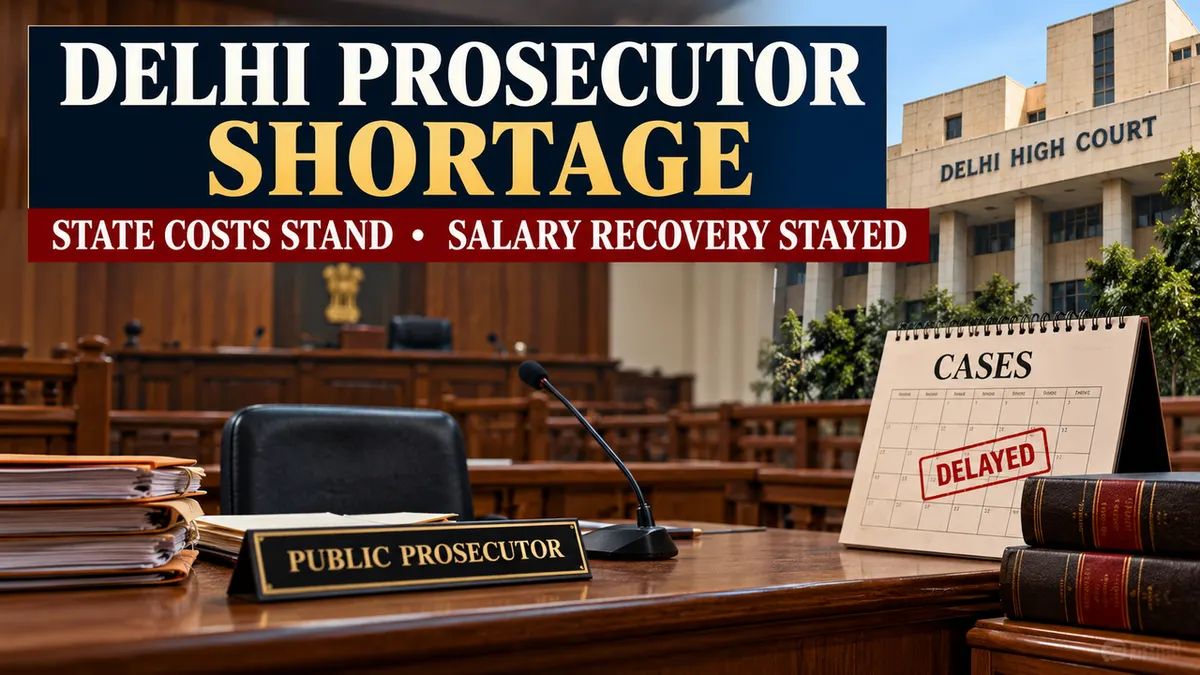
Interim protection in a prosecution dispute
Justice Girish Kathpalia passed the order on 27 October 2026 in Maqsood Ahmed v State NCT of Delhi, Criminal Miscellaneous Case No. 7915 of 2026. The petitioner, serving as Director of Prosecution at Tis Hazari, challenged an order of an Additional Sessions Judge imposing ₹5,000 in costs against the State and directing recovery of that amount from his salary. The trial court had acted after no public prosecutor appeared despite repeated passovers during a criminal proceeding.
The High Court granted limited interim relief. It stayed operation of the direction for recovery from the petitioner personally until the next date. It expressly declined to stay the separate imposition of costs on the State. The distinction matters because the order did not erase the institutional concern that prompted the trial court’s response.
Why the trial court imposed costs
The underlying criminal case arose from an FIR registered in 2002. During a hearing on 6 October 2026, the prosecutor’s absence persisted despite the court waiting through repeated calls. The trial judge imposed costs, apparently responding to delay in a court already managing an extensive docket. The subsequent direction sought to make the prosecution director personally bear the amount if it was not paid.
The High Court acknowledged the pressure on trial courts to dispose of criminal trials and bail matters promptly. But it observed that recovery from an individual officer’s salary, without a specific finding of malfeasance or misfeasance, appeared prima facie improper. That is an interim assessment, not a final adjudication of all questions of responsibility.
Prosecutor shortage before the High Court
Counsel for Ahmed submitted that the capital faced an acute shortage of public prosecutors and additional prosecutors, with some officers on leave. It was also submitted that the larger shortage issue was already pending before a Division Bench of the High Court. These were submissions advanced to explain the circumstances of non-appearance and the challenge to personal recovery.
Justice Kathpalia separately expressed concern that the shortage had become a perennial problem affecting criminal trials and even bail matters. The order records that nothing before the Court demonstrated serious steps by the State to address it. The Court also noted that the State itself had not challenged the costs order, which supported refusing a stay of the State’s liability.
Personal liability versus institutional accountability
The decision illustrates two different forms of accountability. A court may respond to avoidable disruption by imposing costs on the State, yet a direction to recover those costs from a particular official’s salary requires an appropriate basis. The High Court’s interim approach protects against immediate personal recovery without removing scrutiny of the administration’s failure to provide prosecutors.
This distinction matters for judicial administration because delays in criminal proceedings can arise from staffing arrangements rather than the culpable conduct of a single officer. An effective response may require recruitment, deployment, leave management and systematic coordination between prosecution offices and courts. The order itself, however, does not prescribe a staffing plan or direct immediate appointments.
Next hearing and significance
The State was permitted to file a detailed reply or status report at least one week before the next listing. The matter was directed to be relisted on 3 February 2027. Until then, the salary-recovery direction remains stayed to the extent specified, while the ₹5,000 costs against the State remain operative.
The case brings an administrative issue into a concrete judicial setting: a missing prosecutor affects a particular hearing, while an entrenched shortage threatens timely access to justice more broadly. The final outcome of the petitioner’s challenge remains open, and the order should not be described as a definitive finding of misconduct against the State or the director.
The order leaves room for the State to explain its staffing position in the detailed report. It is possible for the court to scrutinise whether institutional measures are adequate without attributing every missed hearing to a particular official. That distinction is particularly important in bail matters, where delay may directly affect liberty, and in long-pending trials where witnesses and accused persons face continuing uncertainty.
- Delhi High Court
- Public Prosecutors
- Criminal Trials
- Court Administration
- Prosecution Shortage