HC
Delhi High Court Seeks Replies on PIL Questioning Post Office Digitisation Tender Eligibility
Nyaya Prep • Published • 4 min read
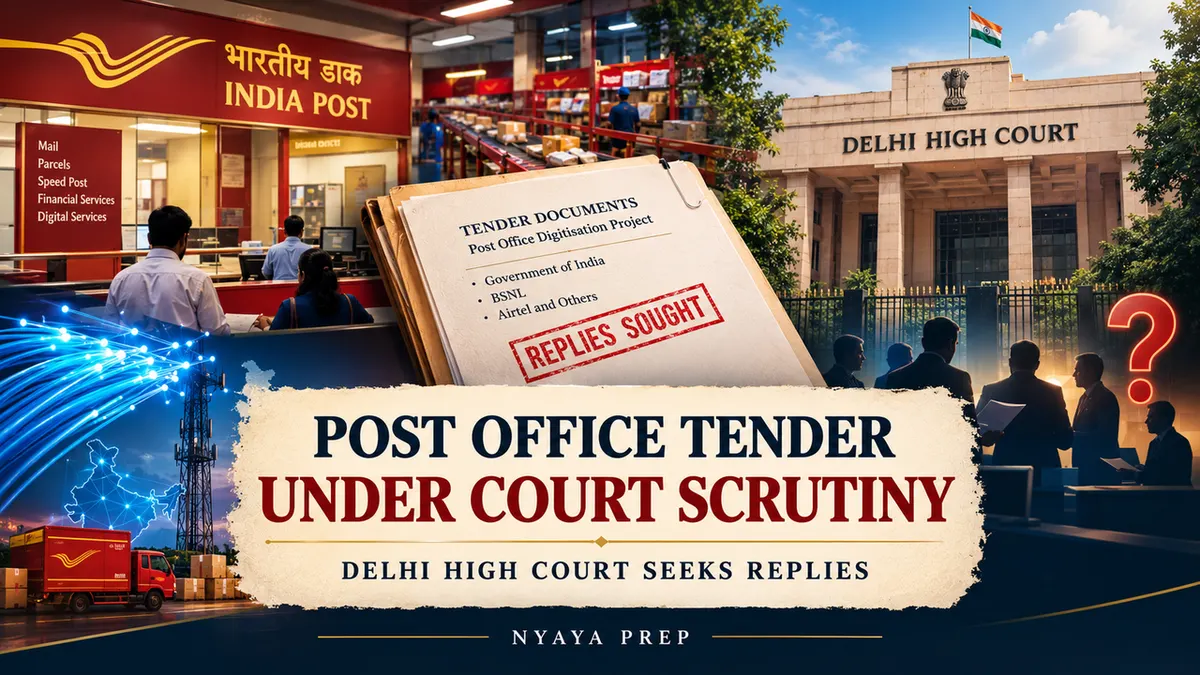
The procedural development
A Division Bench of Acting Chief Justice Nitin Wasudeo Sambre and Justice Sanjay Sharma heard a public-interest litigation brought by Telecom Watchdog on 28 October 2026. The petition questions the treatment of bids for a project involving digitisation of post offices. The High Court sought responses from the Central government, Bharat Sanchar Nigam Limited, Bharti Airtel and other concerned parties, granting two weeks for replies.
Issuing a request for responses is a procedural step. It gives the respondents an opportunity to explain their interpretation of the tender conditions and the decisions already taken. It does not mean that the Court has accepted allegations of corruption, favouritism or ineligibility. Those remain disputed issues requiring examination of the tender record and the parties' submissions.
What the petitioner alleges
The petition concerns a project described as supporting digital postal, banking and insurance services across approximately 27,000 post offices. Telecom Watchdog argues that eligibility conditions restricted participation by telecom service providers and their group companies. It says BSNL should not have permitted certain bids to proceed where the equipment proposed for use was supplied by Lavelle Networks, a company said to have links with Bharti Airtel.
According to the petitioner, Sify Technologies and Pace Digitek quoted equipment associated with Lavelle without the self-certificates that the tender allegedly required. The petition argues that BSNL should have rejected those bids. These statements are allegations about the tender process, not findings recorded by the High Court after adjudication. The actual contractual definition of a group company and the effect of the missing documentation are central questions.
Airtel's investment and the eligibility dispute
The reported case refers to Airtel's investment in Lavelle Networks, including an increase in its stake to approximately 45.6 per cent in 2023. The petitioner says that this relationship amounted to significant influence and should have triggered the tender restriction. It therefore questions the eligibility of bids relying on Lavelle equipment and the sufficiency of the declarations furnished by participants.
BSNL had already rejected the petitioner's complaint in September 2026. Its reported position was that Airtel's shareholding did not establish the type of control over Lavelle's board, management or policy decisions needed to treat the entities as a parent-subsidiary or group company under the tender terms. That response shows why the controversy cannot be resolved solely by mentioning a shareholding percentage. The precise legal and contractual test for control matters.
Earlier steps and the Court's present role
The High Court had earlier directed BSNL, on 9 September, to communicate a reasoned decision on the complaint. BSNL rejected the complaint on 30 September, after which the petitioner pursued the present challenge. The new hearing therefore concerns not only initial bid eligibility but also the adequacy and legality of BSNL's stated reasons for proceeding with the tender process.
Public procurement litigation often requires courts to distinguish a genuine violation of mandatory tender conditions from a disagreement over commercial or technical evaluation. The present record, as reported, does not establish whether the relevant restrictions were mandatory, how group-company status was defined or what materials the bidders actually supplied. Those details must be tested against the tender documents and replies before any firm conclusion is drawn.
Why the matter is important
Digitisation of postal infrastructure affects public-facing services, so the integrity and transparency of procurement decisions have wider administrative significance. At the same time, courts ordinarily avoid substituting their own commercial assessment for that of the procuring authority unless the decision-making process suffers from a legally recognised defect. The competing concerns are fair competition, compliance with announced eligibility rules and continuity of public projects.
The immediate next step is for the respondents to file their replies within the period granted by the High Court. Until further directions emerge, the allegations of favouritism and tender-rule violations should be attributed to the petitioner. No final order invalidating the procurement, cancelling a bid or declaring any company ineligible has been established by the available report.
- Delhi High Court
- Public Interest Litigation
- BSNL
- Tender
- India Post