Taxation
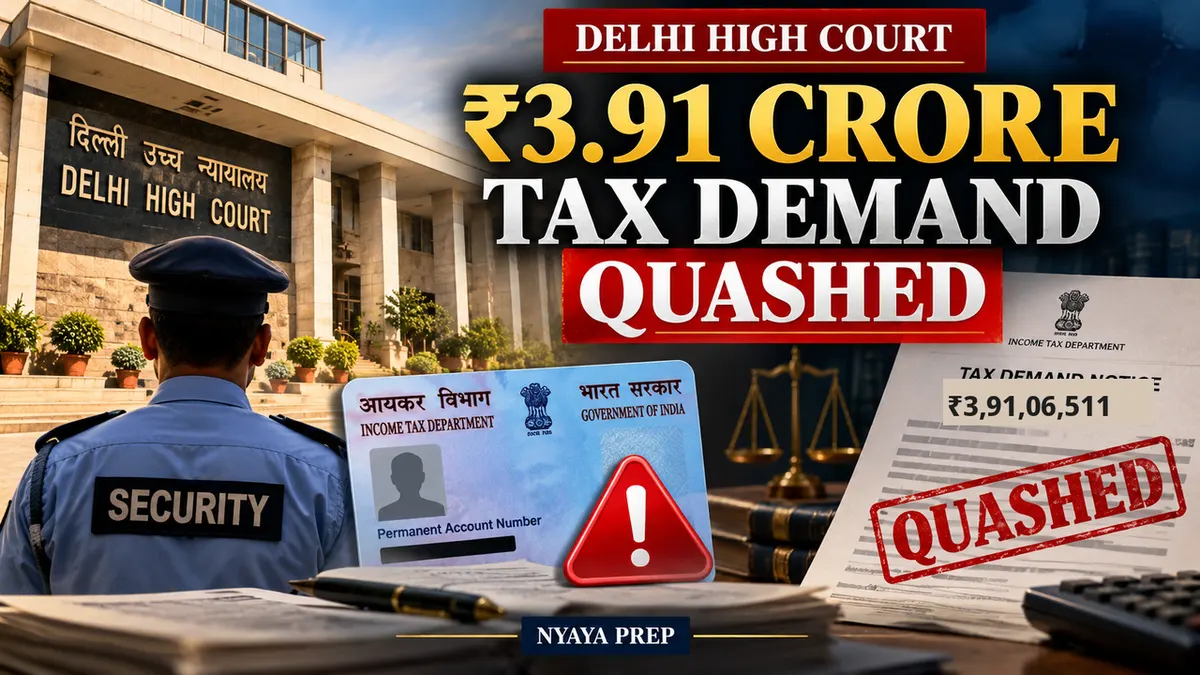
Delhi High Court Quashes ₹3.91 Crore Tax Demand Against Security Guard After Finding No Proof of Business Transactions
Nyaya Prep • Published • Updated • 4 min read
What the Court decided
The Division Bench of Justices Dinesh Mehta and Aditi Choudhary allowed Lalit’s writ petition and quashed the assessment order dated 17 March 2025. The Court found that the assessment rested on electronic tax records without independent inquiry, that adverse material had not been furnished to the petitioner and that his explanation of possible PAN misuse had not been meaningfully examined. The decision does not prevent a fresh assessment if credible material actually links him to the transactions, subject to limitation.
The judgment in Lalit v. Union of India was pronounced on 6 October, although its public reporting emerged during the present news window. It is therefore an account of a newly reported judgment, not a claim that the Court decided the case on 28 October.
How an ordinary worker faced a massive demand
Lalit said he worked through agencies as a security guard and cook at Ashoka Hotel and Vigyan Bhawan during the relevant years. He maintained that he had obtained a Permanent Account Number as an identity document, had never conducted a packaging business and had no taxable income of the scale alleged by the department.
In February 2024, the assessing authority issued a notice under Section 148A(b) referring to entries linked to Montage Enterprises Private Limited. The notice described a cash payment of approximately ₹24.86 crore and a corresponding cash-sale figure of about ₹24.62 crore. Lalit disputed any connection with the business, reported possible identity theft to police and the cyber cell, and requested the supporting transaction records.
The assessing officer nevertheless combined the two figures, treated approximately ₹49.48 crore as turnover and applied an eight-percent computation to arrive at a demand of about ₹3.91 crore. The assessment also contemplated penalty proceedings. The Court noted that the second figure represented a net amount after tax collection, rather than an additional independent transaction.
Natural justice and access to an effective remedy
The Income Tax Department argued that the petitioner should use the statutory appellate process and that disputed factual questions were unsuitable for writ jurisdiction. The Bench disagreed in the exceptional circumstances. It considered the ordinary requirement of depositing around twenty percent of a disputed demand for a stay, which would approach ₹78 lakh in this case, and found that such a route would be practically inaccessible to this petitioner.
The judges linked procedural fairness with Articles 14 and 21 of the Constitution. They referred to the need to disclose adverse material, consider the assessee’s reply and avoid an arbitrary assessment based only on data entries. The Court also recognised the severe mental distress that an enormous recovery demand could impose on a person with very limited resources.
Importantly, the judgment did not establish that every disputed tax assessment can bypass statutory appeals. Its reasoning depended on the combined effect of the unsupported factual premise, lack of inquiry, failure to disclose material and the petitioner’s inability to obtain meaningful interim protection.
What was missing from the tax inquiry
The Bench found no evidence that Lalit carried on a business in plastic packaging or transacted with Montage Enterprises. His bank statements and evidence of contractual employment were not rebutted by a direct investigation. The officer had not even sought details from the alleged counterparty under Section 133(6), a step the Court considered a basic possible inquiry.
The Court also noted that Lalit had referred to provident-fund withdrawals, an Economically Weaker Section certificate and an application for a school-fee waiver for his children. These facts did not automatically decide his tax liability, but they made his explanation sufficiently serious to require objective scrutiny rather than summary rejection.
Practical significance and next step
The ruling highlights the difference between a PAN appearing in a database and proof that its holder carried out the underlying business transaction. Revenue authorities may investigate suspicious entries, but must establish a rational evidentiary connection before converting them into taxable receipts.
The assessment order stands quashed. The department remains free to act afresh only if it obtains cogent evidence identifying Lalit as the person who actually conducted the transactions, and only within applicable statutory time limits. The judgment does not itself identify who, if anyone, misused his PAN.
- Delhi High Court
- Income Tax
- PAN Misuse
- Natural Justice
- Articles 14 and 21