High Court Judgments
Delhi High Court Permits Video Cross-Examination of Elderly Witness Unable to Travel
Nyaya Prep • Published • Updated • 4 min read
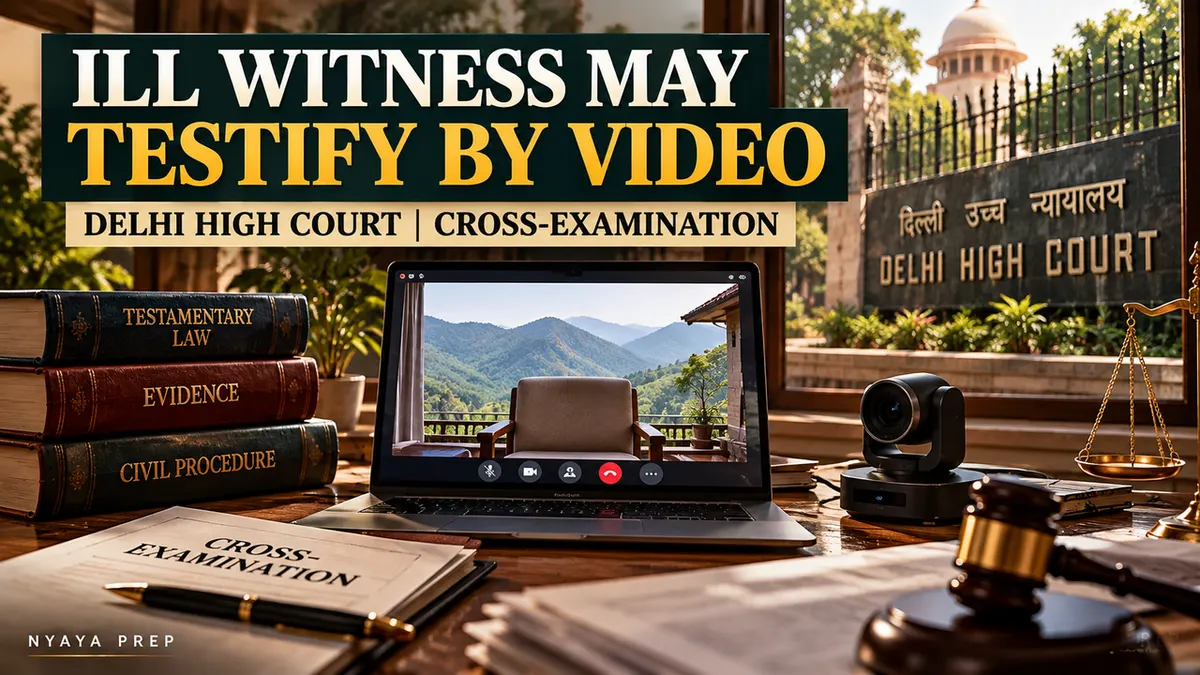
Virtual examination permitted, subject to fairness
The Delhi High Court has permitted the cross-examination of a 71-year-old witness through video conferencing in a testamentary proceeding. Justice Swarana Kanta Sharma allowed the application after considering the witness’s health, her residence in Uttarakhand and the inconvenience caused by several unsuccessful journeys to Delhi. The examination is to take place through a designated video-conferencing facility in Uttarakhand.
The ruling does not establish an unconditional entitlement to remote testimony. The Court stressed that the method must allow meaningful questioning and preserve the opposing party’s right to test the witness’s account. It treated technology as a means of completing evidence fairly, not as a substitute for the safeguards associated with cross-examination.
Three journeys without an examination
The witness was stated to have age-related medical difficulties, and her doctor had advised rest. Despite those circumstances, she had already travelled from Uttarakhand to Delhi on three occasions for cross-examination. None of the visits resulted in completion of the evidence.
On one occasion the respondent’s counsel sought an adjournment because of illness. On another the Court was on leave. On the third, counsel for the petitioner was unavailable because of a bereavement. The High Court considered this sequence relevant to whether another physical journey should be insisted upon. It was not suggested that the witness had caused those repeated adjournments.
Rules governing video-conferencing evidence
The Court examined Rule 13(8) of the Electronic Evidence and Video Conferencing Rules, 2025. That provision allows a person who cannot reach the court or a designated place because of sickness or physical infirmity, or whose presence would involve undue delay or expense, to be examined from an appropriate location through video conferencing.
Rule 13(9) supplies the counterweight. It allows the court to refuse remote examination when the evidence cannot effectively be recorded through that method. The Bench found no demonstrated obstacle of that kind in the present case. The two provisions therefore required the Court to consider both the witness’s practical limitations and the quality of the proposed examination.
Cross-examination remains essential
The High Court expressly recognised cross-examination as an important part of fair adjudication. Questions must be capable of being asked and answered effectively, and the respondent must have a genuine opportunity to challenge the witness’s testimony. The order was not a decision about the truth of the witness’s evidence or the merits of the underlying testamentary dispute.
The Court’s emphasis on a designated facility matters. A properly managed connection and court-supervised procedure can help establish who is giving evidence and permit the parties to participate without unnecessary disruption. The exact operational arrangements remain subject to the court’s directions and applicable rules, rather than assumptions about informal video calls.
A pragmatic answer to avoidable delay
The Bench considered that another journey could impose avoidable hardship on an elderly person who had already complied with repeated requests to attend. Insisting on physical presence without identifying a fairness-related necessity would risk prolonging the litigation while adding to the witness’s difficulty.
The Court therefore adopted a practical approach: allow the examination to proceed remotely while retaining safeguards. It did not dispense with the examination or reduce the burden of proving facts in the case. The parties remain responsible for completing evidence through the permitted procedure.
Wider relevance for trial management
The decision is relevant to courts handling witnesses with disabilities, illness or substantial travel constraints. It shows how a judge may assess an application individually rather than treating physical attendance as the only acceptable format. The existence of a technical facility alone is not enough; the procedure must remain fair to all parties.
For litigants, the ruling reinforces the need to place concrete medical and travel circumstances before the court and to explain how remote examination can be conducted reliably. For courts, it illustrates how procedural rules can prevent delay without weakening the adversarial testing of evidence.
Case Details
Case: Testamentary proceeding involving a 71-year-old witness
Bench: Justice Swarana Kanta Sharma
Advocates: Rohan Khanna; Abhinav Singh; Pearl Khurana; Shantanu Patel; Shumaila; Rajeshwar Kumar Gupta
Relevant Bare Act
- Delhi High Court
- Video Conferencing
- Cross Examination
- Witness
- Testamentary Law