HC
Delhi High Court Issues Notice on Challenge to Blocking of Bring Back Ballot Instagram Account
Nyaya Prep • Published • Updated • 4 min read
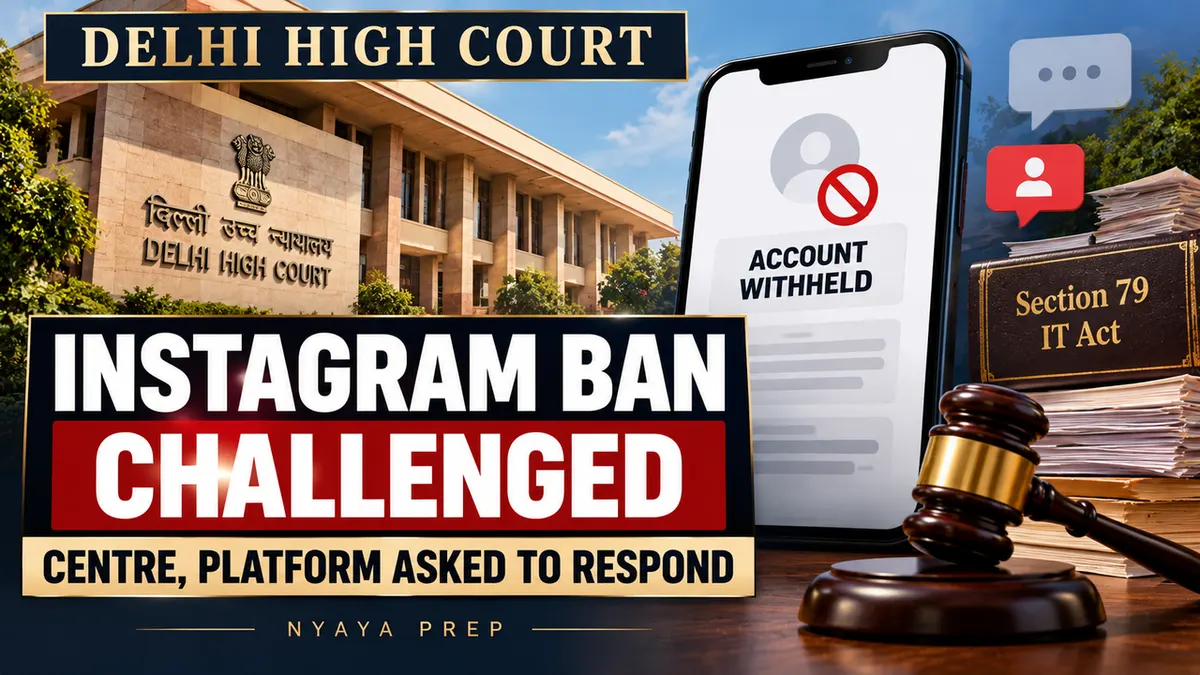
Notice issued in account-blocking dispute
Justice Amit Mahajan of the Delhi High Court issued notice in Mission Save Constitution and another v. Union of India and others, W.P.(C) 15710 of 2026. The order, dated 27 October 2026, concerns a challenge to the suspension or withholding of an Instagram account used by an organisation campaigning on electoral issues. The Court recorded the petitioners' grievance and directed notice to the respondents, with a returnable date of 6 November. The order does not grant final relief, direct reinstatement of the account or determine that the underlying government instruction was unlawful.
What the petitioners allege
The account, called Bring Back Ballot, was associated with advocate Mehmood Pracha and Mission Save Constitution. According to the petition, the account became unavailable in India on 10 October, when a protest advocating a return to paper ballots was planned. The petitioners say they received no advance notice, hearing, reasons or copy of an official blocking direction. They maintain that the account had a substantial following and was used to circulate advocacy material, videos and information about the proposed protest. Those descriptions are allegations made in the writ petition and remain subject to response and judicial scrutiny.
What the signed order actually records
The one-page judicial order records that the petitioner was aggrieved by suspension of the Instagram handle on the instructions of respondent number one. Counsel submitted that the petitioners had not been told the reason for suspension. The order further records counsel's understanding that the action apparently followed instructions under Section 79(3) of the Information Technology Act, 2000. This is a submission recorded by the Court; it is not a final judicial finding identifying the complete statutory basis or validity of the restriction. The operative direction is simply to issue notice.
Service of notice and the next date
Counsel appearing for respondent number four accepted notice before the Court. Notice to respondents one to three was directed through the Central Government Standing Counsel, returnable on 6 November 2026. The record therefore shows that the litigation has entered the response stage. It does not show an interim direction requiring the platform to restore the account. Any later application for interim relief, filing of a reply or further order must be assessed separately rather than inferred from the initial notice.
Constitutional issues raised
The petitioners invoke freedom of speech and expression, peaceful assembly and association under Article 19 of the Constitution. They contend that restricting an account used for political advocacy without disclosing the reasons impairs those protections. The legal issues may include the authority for the blocking instruction, the procedure followed, the platform's compliance obligations and the availability of a meaningful opportunity to contest the action. However, the High Court has not yet resolved those issues. A notice to respondents allows the Court to obtain their account of the facts and the applicable legal framework.
Why the distinction matters
Online restrictions may have immediate practical consequences for public communication, particularly when the account is used to organise meetings or share political views. Equally, the existence of a challenge does not establish that the platform or government acted illegally. A legally careful report must distinguish the petitioners' claim that no reasons were furnished from any defence that the respondents may later provide. It must also distinguish Section 79 intermediary obligations from the broader legal architecture governing content restrictions, without assuming a particular procedure that the order itself does not identify.
Operative position
The matter remains pending before the Delhi High Court. The respondents have been notified and the next date is 6 November 2026. The existing restriction has not been judicially set aside in the order examined. The petitioners can press their constitutional and procedural objections, while the government and platform may file their responses. The case demonstrates the importance of precise reporting on digital-rights litigation: issuance of notice signals that the dispute will be heard, not that the Court has accepted the petitioners' legal arguments.
Case Details
Mission Save Constitution and another v. Union of India and others; W.P.(C) 15710 of 2026; Delhi High Court; order dated 27 October 2026.
- Delhi High Court
- Digital Rights
- Free Speech