HC
Delhi High Court Holds Instagram Account Suspension Cannot Be Challenged Against Meta Through Writ Petition
Nyaya Prep • Published • Updated • 4 min read
Court rejects writ route against the platform
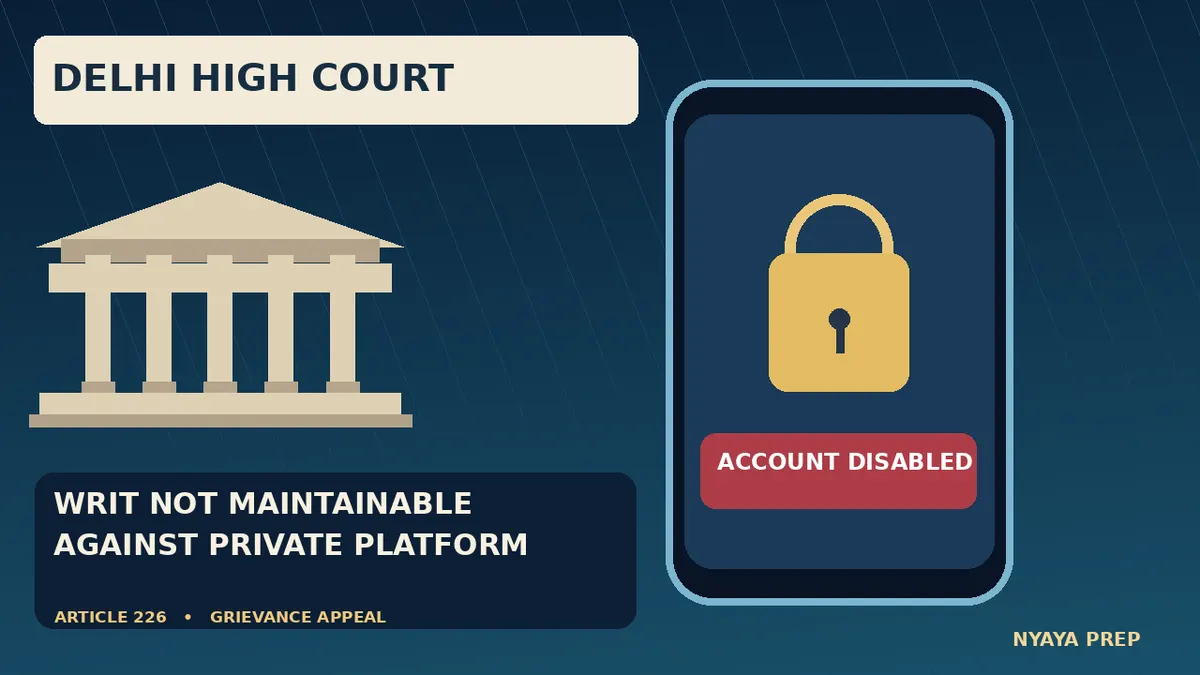
The Delhi High Court has held that the disabling of an Instagram account by Meta Platforms India cannot, on the facts presented, be challenged through a writ petition against the company under Article 226 of the Constitution. Justice Amit Mahajan delivered the order on 27 October 2026 in Sarthak Bhagat v. Union of India and Others, W.P.(C) 15685/2026. The Court disposed of the petition while giving a separate direction concerning the user’s statutory grievance appeal.
The decision rests on the distinction between a private service that is influential in public debate and an entity legally entrusted with a public duty. Public importance does not, by itself, make every activity a public function. The Court did not adjudicate whether the original account suspension complied with Meta’s contractual rules or the merits of the user’s complaint.
Why the user approached the High Court
The petitioner said his Instagram accounts had been disabled without prior notice or a meaningful opportunity to respond. According to the order, the message supplied by the platform referred generally to a breach of community standards. The petitioner contended that he attempted the in-app review process, but the accounts were not restored and he was not given specific reasons for the decision.
He also stated that he filed an appeal before the Grievance Appellate Committee on 11 September 2026 under Rule 3A of the Information Technology (Intermediary Guidelines and Digital Media Ethics Code) Rules, 2021. He complained that the appeal remained pending beyond the period contemplated by those rules. These were the petitioner’s submissions, rather than findings that Meta had necessarily acted unlawfully.
When a private body may face a writ
Justice Mahajan explained that Article 226 can reach a private entity where the impugned activity is performed in discharge of a public function or duty. The inquiry examines the nature of the function, its connection with a State obligation and whether authority is conferred by law. The status of the organisation as private is not conclusive, but the presence of a genuine public-law obligation is essential.
The Court accepted that Instagram plays a significant role in sharing information and shaping public opinion. It nevertheless considered the provision of a communication platform to be a voluntary, user-driven private service, not a delegated governmental function. The public conversation occurring on the platform was described as a consequence of the service rather than the discharge of a statutory public duty.
Earlier precedent and the civil remedy
The order referred to Sanchit Gupta v. Union of India and Another, 2024 SCC OnLine Del 5880, when explaining why a platform’s communications role does not automatically make it amenable to a constitutional writ. Applying that approach, the Court held that Meta did not discharge the kind of public function needed to sustain the requested relief under Article 226.
Justice Mahajan indicated that an ordinary civil suit would be a more appropriate legal route against the private company, including for damages if a legally supportable claim existed. That observation should not be read as an award of damages, an order restoring the account or a finding that a particular contractual claim would succeed. Those questions were not tried in this writ proceeding.
Government oversight and the grievance appeal
The petitioner also asked the Court to direct the Union government to secure Meta’s compliance with obligations under the Information Technology Act, 2000 and the 2021 Rules. The High Court declined that relief because a mandamus requires an identifiable statutory duty and a demonstrated failure to perform it. On the pleadings before it, the Court did not find the necessary foundation for a coercive direction against the government.
The Court took a different approach to the pending statutory appeal. Rather than determining the account-restoration issue itself, it directed the Grievance Appellate Committee to decide the petitioner’s appeal expeditiously. The order did not prescribe a new fixed deadline or instruct the Committee to allow the appeal. The administrative remedy must therefore be pursued on its own merits.
Why the distinction matters
The ruling is significant for users challenging moderation decisions by large digital intermediaries. It separates three possible questions: whether the private platform has breached a contractual or other enforceable obligation, whether the government has failed to discharge a particular statutory duty, and whether a grievance authority has dealt with an appeal within the applicable framework.
For future litigants, the practical lesson is that selecting the correct forum and identifying a precise legal duty can be as important as the underlying grievance. The judgment does not declare social-media moderation beyond legal scrutiny. It instead limits the constitutional writ remedy on these facts while leaving ordinary civil proceedings and the pending statutory appeal conceptually distinct.
- Delhi High Court
- Article 226
- Meta
- Information Technology Rules
- Grievance Appellate Committee