Constitutional Law
Delhi High Court Disposes of ₹50 Crore Protest Compensation PIL, Directs Petitioner to Supreme Court
Nyaya Prep • Published • 3 min read
The High Court’s procedural decision
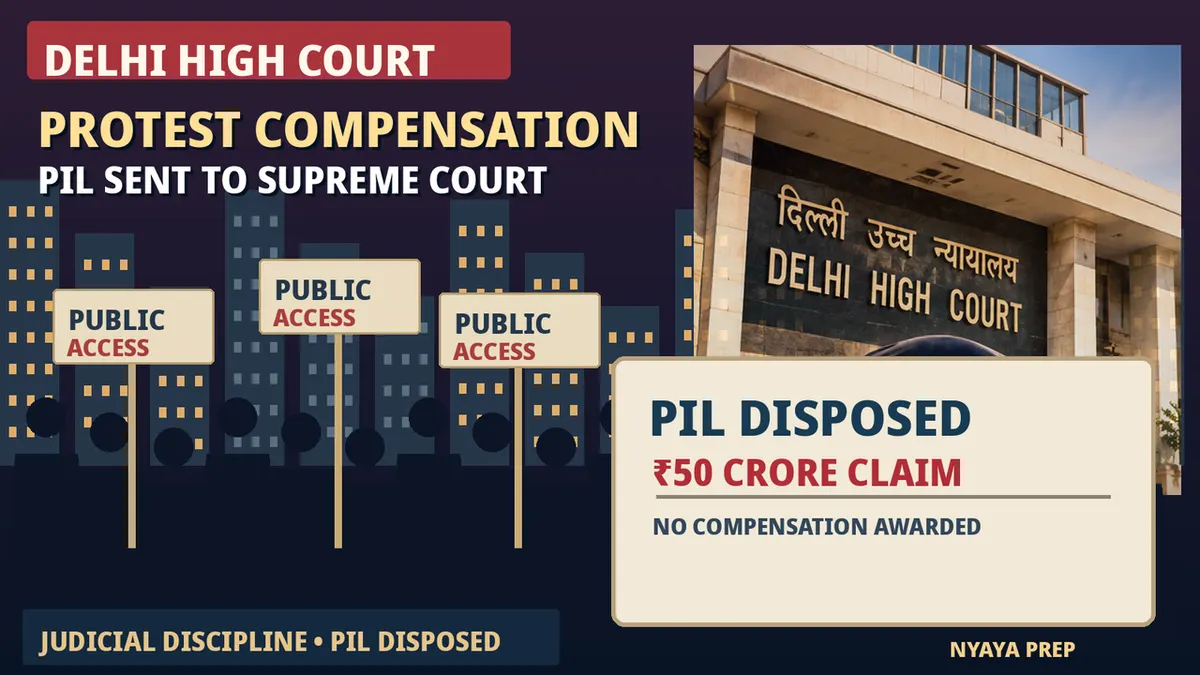
A Division Bench of Acting Chief Justice Nitin Wasudeo Sambre and Justice Sanjay Sharma declined to adjudicate the petition’s substantive compensation claims. It noted that similar issues arising from demonstrations were already under consideration by the Supreme Court and that judicial discipline required avoiding potentially conflicting directions.
The Bench disposed of the petition while leaving the petitioner free to approach the apex court. It neither ordered the payment of ₹50 crore nor decided that the organisers were legally liable for the alleged public inconvenience. The distinction is central to understanding the outcome.
What the petition sought
The petitioner, advocate Rakesh Kumar Saini, complained that demonstrations by the Cockroach Janta Party and associated participants had disrupted movement and everyday activities in parts of Delhi. The allegations referred to protests around Jantar Mantar and claimed inconvenience to residents, traders, commuters, workers and students.
The petition sought directions to public authorities to initiate action and develop a framework for community fines or compensation. It also proposed a high-powered committee that could receive claims from affected citizens and assess the amounts payable. An interim figure of ₹50 crore was advanced as a proposed fund or compensation measure.
These were allegations and requests made in litigation, not factual findings by the High Court. The Court did not conduct a trial into the organisers’ conduct, quantify damage or identify individual beneficiaries entitled to payment.
Why the Supreme Court proceedings mattered
The Solicitor General informed the High Court that the Supreme Court was dealing with similar issues. The High Court considered the overlap important because orders from separate courts on related public protests and compensation questions could create uncertainty or inconsistent obligations.
Judicial discipline is a principle governing how courts exercise jurisdiction when another court, especially the Supreme Court, is already seized of substantially related proceedings. The High Court’s approach in this case was to leave the issue for consideration in that forum rather than issue a parallel compensation direction.
The petitioner argued that his request for monetary redress was distinct from cases primarily seeking restrictions or regulation of demonstrations. The Bench nevertheless considered it preferable that he raise the matter before the Supreme Court.
Competing rights remain open for consideration
The case reflects a recurring tension between the constitutional importance of peaceful assembly and the rights of people who must use public roads, reach workplaces, attend school or conduct business. The petition placed particular emphasis on the latter group and urged the creation of a mechanism to address disruption.
However, the present decision does not create a general rule that protest organisers must pay compensation whenever traffic or public movement is affected. Any such conclusion would require examination of the legal basis for liability, the facts of the alleged disruption, causation, the affected persons and the proper form of relief.
Equally, the disposal should not be described as judicial approval of every aspect of the protests. The High Court did not reach the merits, so neither side obtained a substantive ruling vindicating its position on compensation.
What happens after disposal
The petitioner may seek to place his claims before the Supreme Court in accordance with applicable procedure. Whether that Court entertains a separate application, permits intervention in existing matters or grants any relief remains open.
For legal observers, the development is primarily about forum selection and the avoidance of parallel judicial orders. The immediate operative result is the disposal of the High Court PIL, not an award, penalty or final determination of responsibility for the protests.
- Delhi High Court
- Public Interest Litigation
- Right to Protest
- Compensation
- Judicial Discipline