Consumer Law
Consumer Authority Fines Shangri-La Eros ₹1 Lakh for Automatically Adding Restaurant Service Charge
Nyaya Prep • Published • 4 min read
What the consumer regulator ordered
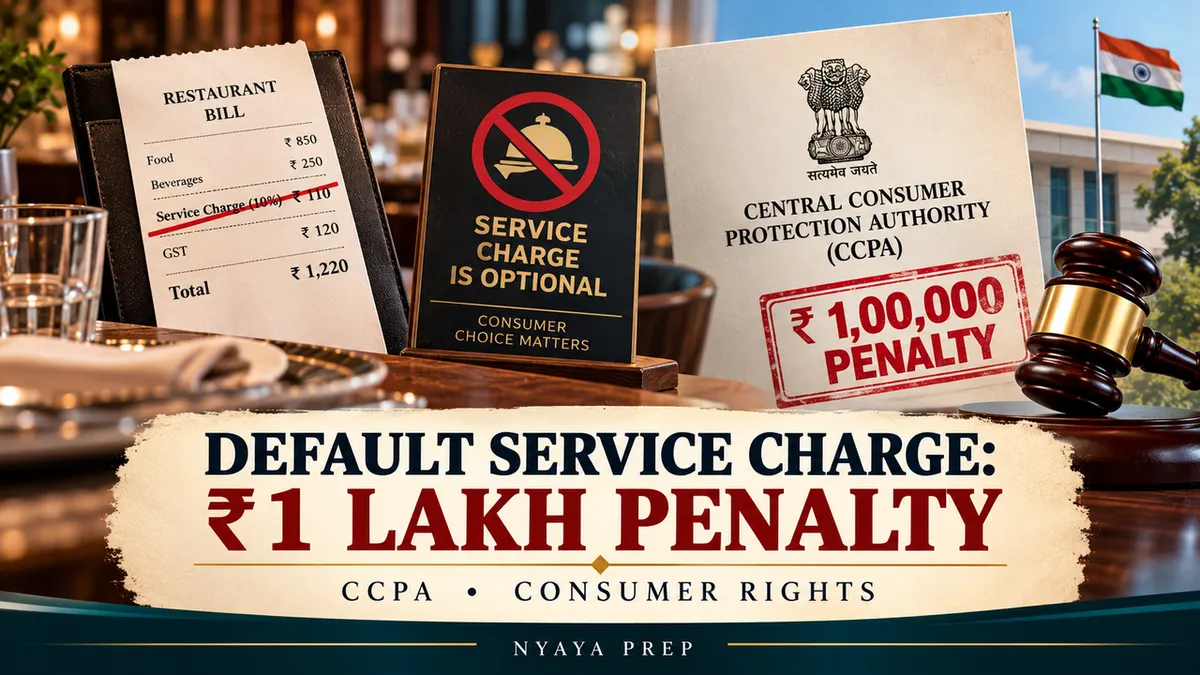
In an order dated 22 October 2026, the Central Consumer Protection Authority imposed a penalty of ₹1 lakh on Shangri-La Eros, New Delhi, following complaints about the billing practices of its Mister Chai restaurant. The regulator directed the establishment to discontinue and refrain from automatically collecting a service charge, whether described by that name or by another expression. It also required strict compliance with the applicable service-charge guidelines and a compliance report within 15 days of receiving the order.
The decision concerns the difference between a voluntary payment chosen by a diner and an amount that the restaurant's billing software adds before the diner makes that choice. The regulator treated the latter as an unfair practice. Its decision does not prevent a customer from voluntarily rewarding staff; it rejects making customers responsible for identifying and removing a charge already inserted into the bill.
Complaints and investigation
The case arose from consumer grievances concerning food bills issued in May and June 2025. The complaints alleged that the restaurant added a 10 per cent service charge to the food subtotal and then calculated taxes on the resulting amount. One reported invoice showed ₹435 added to a ₹4,350 subtotal, while another showed ₹125 added to ₹1,250. These examples formed part of the material examined during the regulatory process.
Following a preliminary inquiry, the authority issued a notice to the hotel in July 2025. The Director General (Investigation) subsequently examined the practice and submitted findings. The regulator considered the investigation, the hotel's explanations and the manner in which the charge was presented to customers. The inquiry therefore concerned a recurring billing mechanism, rather than only the individual refunds sought by complainants.
The hotel's defence
Shangri-La Eros disputed that the service charge was compulsory. It said its menu informed guests that the charge was discretionary and that diners could request a waiver or seek a refund. It also changed the description on its billing material to refer to a voluntary staff contribution. The hotel informed the regulator that it had refunded the relevant complainant and had discontinued automatic collection across its outlets with effect from 1 October 2026.
Those submissions were relevant to the regulatory assessment but did not dispose of the complaint. The authority considered whether the customer had genuinely opted in before the charge appeared on the bill. A refund after payment, or a statement that the charge could be waived, did not in its view cure the absence of a prior voluntary choice.
Why an opt-out charge was rejected
The CCPA reasoned that restaurants are free to set menu prices and that the displayed price ordinarily includes the cost of providing the service. A customer ordering from the menu agrees to pay that disclosed price and applicable statutory taxes. Automatically inserting an additional non-statutory amount creates a different transaction, especially when the customer must object at the counter to have it removed.
The authority rejected the argument that changing the label to 'voluntary staff contribution' altered the legal position while the billing system continued to add the amount by default. It applied the Consumer Protection Act, 2019, and the 2022 guidelines on preventing unfair trade practices in the levy of service charges. The regulator considered the continued practice, the possibility of pressure on diners and the wider class of consumers affected by the billing system.
Consumer rights and compliance
The order illustrates the practical meaning of informed choice in consumer transactions. A voluntary tip should arise from an affirmative decision by the customer, not from an amount printed on the invoice that the customer may feel uncomfortable challenging. The regulator treated the default addition as a misleading and unfair practice and imposed the monetary penalty under the consumer protection framework.
The immediate compliance obligation is to avoid automatically adding any such charge, including under a renamed description, and to submit the required report within the prescribed period. The hotel has stated that the practice was stopped from 1 October 2026. The existence of that statement should be distinguished from independent verification of implementation across every outlet. The broader lesson is that transparency in a menu does not substitute for genuine customer consent at billing.
Relevant Bare Act
Consumer Protection Act, 2019, Section 2(47), 21(7).
- CCPA
- Consumer Protection Act
- Service Charge
- Restaurants
- Consumer Rights