Tribunal
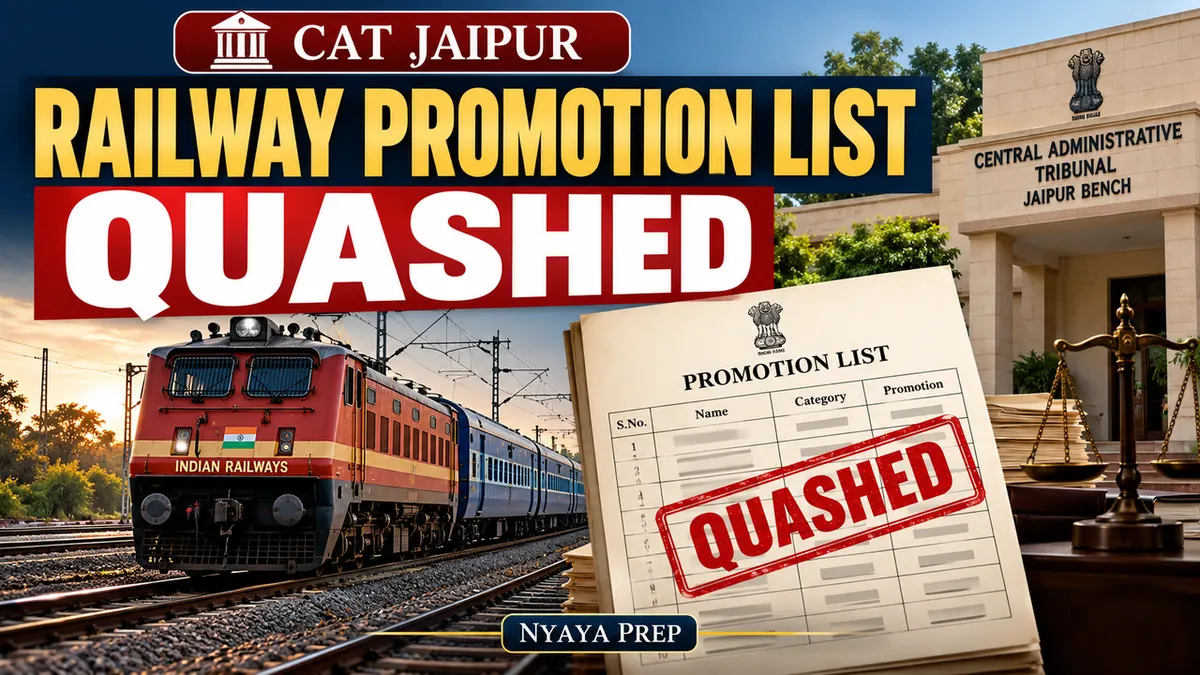
Central Administrative Tribunal Quashes Railway Promotion Notification Over Supreme Court Undertaking
Nyaya Prep • Published • 3 min read
Tribunal allows three applications
A bench comprising Judicial Member Ranjana Shahi and Administrative Member Lok Ranjan delivered its decision on 19 October 2026 in three connected original applications, including Puncham Singh v Union of India. Railway employees challenged promotions against unreserved roster points in the background of long-running litigation over reservation in promotion. The tribunal set aside the impugned notification of 16 February 2023 and directed the department to draw up fresh eligibility and suitability lists.
The judgment should be read as a determination of the particular service dispute and the binding interim undertaking discussed in it. It does not itself decide the ultimate constitutional validity of all reservation-in-promotion arrangements. The Supreme Court proceedings forming the background to the undertaking were described as pending.
What the Solicitor General had undertaken
During contempt proceedings connected with Samta Andolan Samiti v Sanjay Kothari in September 2016, the then Solicitor General communicated an assurance that further promotions of reserved-category employees against unreserved posts would not be made by relying on specified 2010 circulars. The Railway Board subsequently placed its related circular in abeyance. The tribunal reproduced the communication and examined later departmental efforts to justify promotions by reference to other instructions.
The tribunal considered it significant that the Supreme Court had refrained from further interim intervention in light of the undertaking. A department could not treat the assurance as optional simply by stating that promotion orders were subject to the outcome of pending special leave petitions. The tribunal viewed the undertaking as continuing to constrain the impugned action.
Dispute over own-merit promotion
The controversy centred on whether employees who had entered service or advanced using reserved vacancies could later claim promotion against unreserved points on an own-merit basis in the circumstances governed by the undertaking. The Railways referred to decisions and administrative instructions concerning reservation and merit. The tribunal distinguished rules applicable to initial recruitment from the particular promotion arrangements before it.
It also discussed judicial decisions addressing the continued effect of the undertaking, including a Kerala High Court decision. The tribunal rejected the proposition that later instructions automatically displaced the restraint that had been represented to the Supreme Court. The conclusion was framed against the interim position prevailing in the connected litigation.
Why the tribunal criticised the department
The tribunal criticised attempts to reinterpret judgments and the former Solicitor General’s communication in ways that would undermine the assurance. Its concern was not merely technical. Interim undertakings influence how courts manage ongoing litigation and may determine whether immediate coercive orders are considered necessary.
The decision demonstrates the importance of tracing the exact source of an administrative power and the limits placed on its exercise by judicial proceedings. A circular issued later cannot necessarily erase a specific commitment made to a constitutional court. At the same time, the ruling should not be presented as a nationwide final determination that reserved-category employees can never compete for unreserved posts in any setting.
Directions and next stage
The tribunal allowed all three original applications, quashed the February 2023 notification and directed the Railways to prepare fresh eligibility and suitability lists in accordance with its decision. It made no order as to costs. The decision is subject to any remedies available under the applicable law and to developments in the pending higher-court litigation.
For public-sector employers, the immediate practical message is to reconcile promotion exercises with operative judicial directions and undertakings before issuing lists. For affected employees, the judgment highlights that procedural and interim constraints can be decisive even while the broader law remains contested.
The precise scope of the tribunal's directions should be understood against the date and terms of the Supreme Court undertaking. A later final judgment in the underlying reservation litigation could affect the legal framework, and any challenge to the CAT decision would be considered through the proper judicial route. The immediate administrative task remains compliance with the operative decision rather than speculative predictions about those future proceedings.
- Central Administrative Tribunal
- Railway Promotions
- Reservation
- Service Law
- Jaipur Bench