SC
CCTV Footage Clears Accused: Supreme Court Quashes Criminal Proceedings Under Section 528 BNSS When Reliable Evidence Disproves Allegations
Nyayavat • Published • Updated • 3 min read
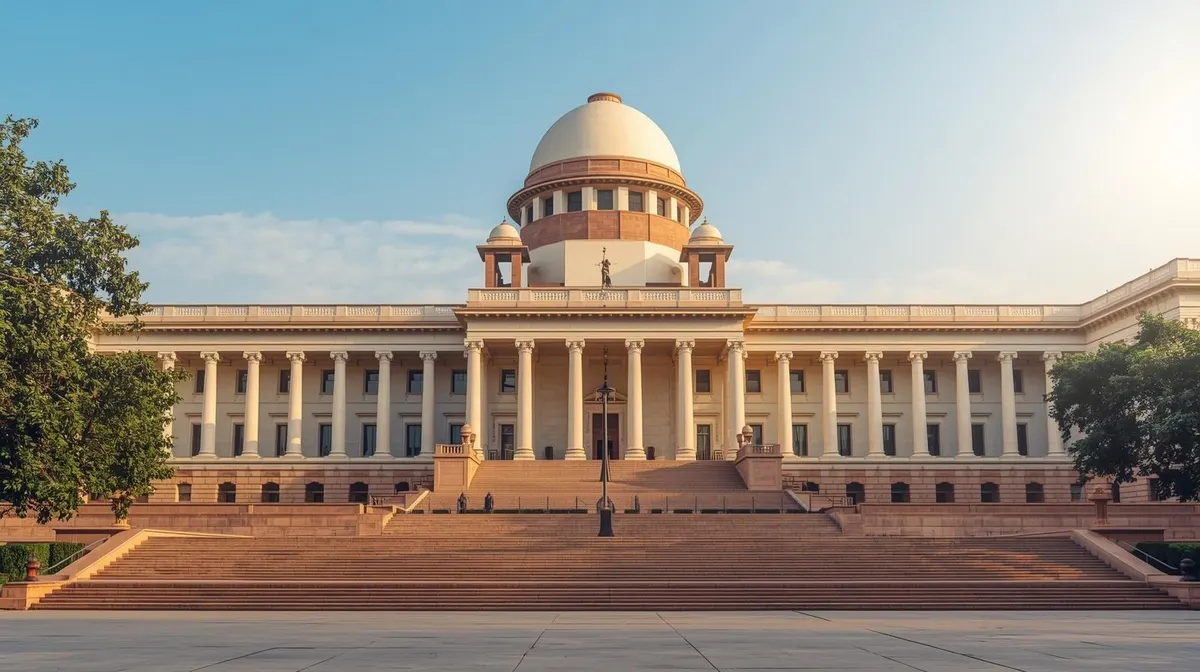
The Supreme Court of India, in the case of Sajal Bose v. State of West Bengal and Ors. (2026 LiveLaw (SC) 335), delivered a significant ruling on April 6, 2026, regarding the power of courts to quash criminal proceedings under Section 528 of the Bharatiya Nagarik Suraksha Sanhita, 2023 (BNSS), which is the successor provision to Section 482 of the Code of Criminal Procedure (CrPC).
A three-judge bench comprising Justices Vikram Nath, Sandeep Mehta, and NV Anjaria held that when the prosecution fails to rebut reliable and unimpeachable material that effectively undermines the factual foundation of a complaint, the Court is justified in exercising its inherent power to quash the proceedings.
The judgment was authored by Justice Sandeep Mehta.
(b) Facts of the Case
The case arose from an incident that took place in October 2022 inside an apartment complex in Kolkata, West Bengal. The key facts are as follows:
A 77-year-old complainant alleged that he and his family members were assaulted and threatened by several individuals residing in the same complex.
An FIR was registered under multiple provisions of the Indian Penal Code (IPC), including sections related to unlawful assembly, hurt, and criminal intimidation.
During investigation, CCTV footage from within the premises was collected and made part of the prosecution's own charge sheet.
The Calcutta High Court quashed proceedings against two co-accused persons, finding no specific allegations against them. However, it refused to extend similar relief to the three appellants in the present case.
The three appellants then approached the Supreme Court by way of an appeal, challenging the Calcutta High Court's refusal.
(c) Legal Issues
The Supreme Court was called upon to examine the following legal questions:
Whether the High Court was justified in refusing to quash proceedings against the appellants despite the existence of CCTV footage that contradicted the prosecution's case?
Whether courts can look into unimpeachable documentary or video evidence at the stage of quashing proceedings, even before a trial begins?
What is the correct legal test to be applied by a court when reliable material produced by the accused effectively disproves the allegations made in the complaint?
(d) Court's Observations
The Supreme Court carefully examined the CCTV footage that had been relied upon by both parties during the course of arguments. The Court made several important observations.
On the role of CCTV footage:
The bench noted that the footage, rather than supporting the prosecution's allegations, showed the appellants pacifying the situation and not participating in any act of assault or aggression. The Court observed:
"The footage, which was heavily relied upon by both sides during the course of arguments, upon careful scrutiny, does not depict the appellants participating in any act of assault or overt aggression, thereby substantially dislodging the factual foundation of the allegations against them."
The Court further noted that this material was unrefuted by the prosecution in any meaningful manner and could not be lightly set aside even at the preliminary stage of quashing.
On the power to quash proceedings:
The Court reiterated the legal principle that where credible material displaces the factual basis of accusations and the prosecution is unable to counter it, the Court is justified in invoking its inherent jurisdiction. In the Court's own words:
"Where reliable and unimpeachable material demonstrably displaces the factual basis of the accusations and the prosecution is unable to effectively counter the same, the Court would be justified in invoking its inherent jurisdiction to prevent injustice."
The Court also emphasised that continuing such proceedings would amount to misuse of the criminal process and waste precious judicial time on cases that carry no reasonable prospect of ending in conviction.
On the four-step test from Pradeep Kumar Kesarwani:
The Court applied the framework laid down in Pradeep Kumar Kesarwani v. State of Uttar Pradesh (2025 LiveLaw (SC) 880), which provides the following four-step test for quashing petitions:
Step One: Is the material relied upon by the accused sound, reasonable, and of sterling and impeccable quality?
Step Two: Does the material rule out the factual assertions in the charges? Would a reasonable person reject the accusations as false based on this material?
Step Three: Has the material been refuted by the prosecution or complainant, or is it such that it cannot be justifiably refuted?
Step Four: Would continuing the trial amount to an abuse of the process of the court and fail to serve the ends of justice?
The Court found that all four steps were satisfied in the present case, making it a fit case for quashing.
(e) Judgment
The Supreme Court allowed the appeal and quashed all pending criminal proceedings against the three appellants. The Court held that the CCTV footage, which formed part of the prosecution's own charge sheet, conclusively showed that the appellants were not involved in any act of violence. Since the prosecution failed to rebut this material, continuing the proceedings would serve no purpose and would only result in harassment of the accused and waste of judicial resources.
Case Title: Sajal Bose v. State of West Bengal and Ors.
Citation: 2026 LiveLaw (SC) 335
Bench: Justices Vikram Nath, Sandeep Mehta, and NV Anjaria
(f) Legal Significance
This judgment carries considerable importance from both a practical and academic standpoint, particularly for judiciary aspirants and legal practitioners. The key takeaways are as follows:
1. Scope of Inherent Powers Under Section 528 BNSS:
This case reinforces that Section 528 BNSS (formerly Section 482 CrPC) grants wide inherent powers to courts to quash proceedings where continuing them would cause injustice or amount to an abuse of process.
2. Video Evidence at the Quashing Stage:
The judgment confirms that courts are not required to ignore credible video evidence simply because a trial has not yet commenced. Where such evidence is part of the prosecution's own record and is uncontroverted, courts can and should take it into account.
3. Four-Step Test Reaffirmed:
The Pradeep Kumar Kesarwani framework has now been applied and reaffirmed by a three-judge bench, giving it greater precedential weight. This test is a useful tool for courts and practitioners dealing with quashing petitions.
4. Protection Against Misuse of Criminal Law:
The ruling protects citizens from being subjected to prolonged and baseless criminal trials. It sends a clear message that criminal proceedings cannot be sustained where objective material clearly disproves the allegations made.
5. Relevance for Judiciary Exams:
For those preparing for judicial service examinations, this case is relevant under the following topics:
Inherent powers of courts under CrPC and BNSS
Quashing of FIR and criminal proceedings
Role of electronic and video evidence in criminal law
Principles of abuse of process and ends of justice
This judgment is a reminder that the criminal justice system must balance the rights of victims to seek justice with the rights of accused persons to be free from frivolous and unsubstantiated prosecution.
- Criminal Law
- Section 528 BNSS / Section 482 CrPC
- Supreme Court
- Abuse of ProcessInherent Jurisdictionof India
- Quashing of Criminal Proceedings
- CCTV Evidence