HC
Calcutta High Court Declines Interim Stay on Kolkata Ward Delimitation and Seeks State Reply
Nyaya Prep • Published • Updated • 4 min read
What the High Court decided
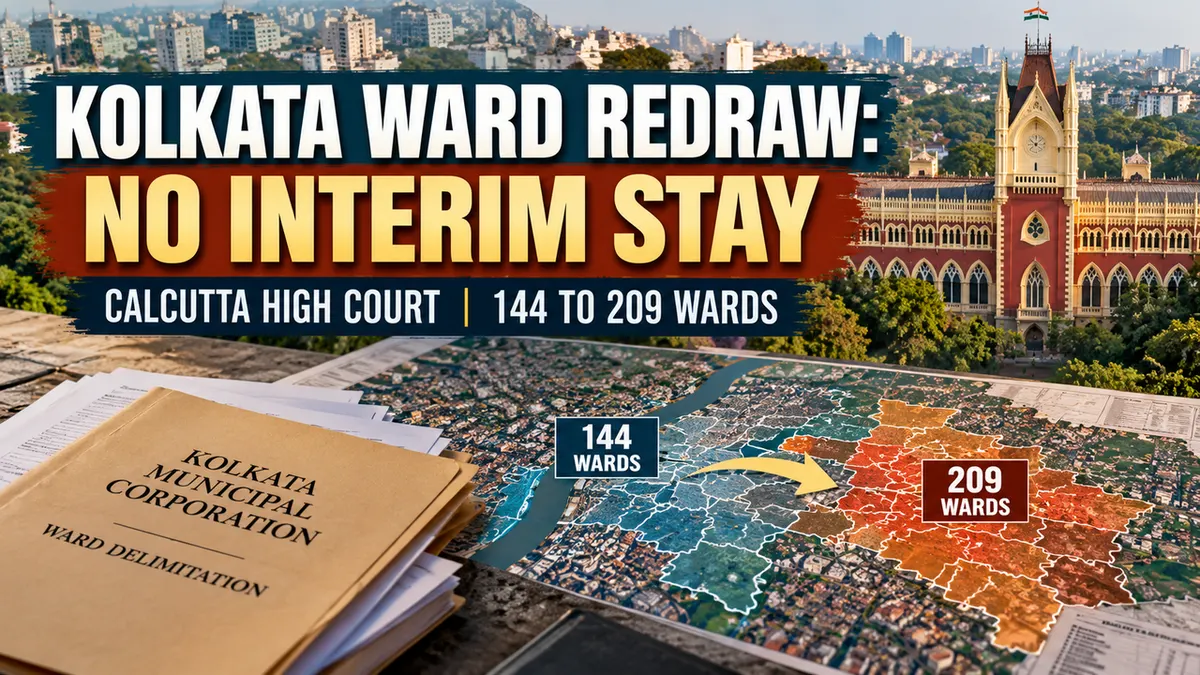
Justice Hiranmay Bhattacharyya refused to stay a September 2026 notification changing the ward boundaries of the Kolkata Municipal Corporation. The proposed restructuring increases the number of wards from 144 to 209. The Court also declined an interim request to restrain the State Election Commission from proceeding on the basis of the revised boundaries.
The Court required the State to answer the petitioner’s allegations within three weeks. The interim refusal does not amount to a final ruling that every aspect of the delimitation exercise is valid. The writ petition remains pending and the merits can be examined after the State’s response and further hearing.
How the municipal dispute arose
The petition was brought by Dipu Das, a former councillor. It challenges a notification dated 11 September 2026 that redraws municipal boundaries and expands the number of councillor seats. The petitioner alleges that the authorities acted without sufficient procedural safeguards and without a rational basis for some ward boundaries.
According to the petition, affected political participants were given an inadequate opportunity to make objections or propose alternative boundaries. The petitioner further alleges that the objections that were submitted were not meaningfully considered.
These allegations have not been accepted as proven facts by the Court. The government and municipal authorities dispute the procedural and political criticisms. The case therefore concerns contested facts as well as the interpretation of the powers used to conduct delimitation.
Disparity in ward populations
The petition highlights alleged differences in the number of electors assigned to the proposed wards. It cites an average of approximately 15,149 voters per ward but claims that some wards contain substantially fewer voters while others have more than 20,000.
One comparison placed before the Court concerned a ward with approximately 5,655 voters and another with more than 28,000. The petitioner argued that such disparities could undermine equal representation unless supported by objective geographical and demographic considerations.
These figures are assertions from the petition and are not a judicially verified audit of the revised electoral map. The eventual legal question is whether the governing municipal statute permits the adopted boundaries and whether the administrative process satisfies applicable constitutional and statutory standards.
Arguments on statutory power and procedure
Senior Advocate Bikash Ranjan Bhattacharyya, for the petitioner, argued that the Municipal Commissioner could not assume functions reserved to an elected municipal body. He also questioned the sequence in which statutory amendments and boundary notifications were undertaken.
The petition refers to Section 601 of the Kolkata Municipal Corporation Act, 1980 in alleging misuse of delimitation powers, while counsel also raised an argument concerning Section 5(2) and the number of councillors. The legal significance of those provisions remains disputed in this proceeding.
Advocate General Surojit Nath Mitra, appearing for the municipal corporation, contested maintainability and submitted that the required procedure had been followed. The High Court did not finally decide these competing arguments while disposing of the interim request.
Interim relief is not final validation
A court considering a stay application must decide whether the circumstances justify interrupting an ongoing governmental process before a full hearing. Refusal of an interim injunction can leave the impugned notification in operation without resolving the validity of the underlying exercise.
The petitioner’s claims about partisan advantage were presented as allegations. The available account does not establish that the Court found electoral manipulation, improper motive or any constitutional violation. It equally does not establish a final rejection of those claims.
The order preserves the procedural position for further submissions. Any future directions concerning election scheduling, ward boundaries or remedies will depend on subsequent judicial proceedings and the legal framework then applicable.
What happens next
The State must file its response within the three-week period directed by the Court. The petitioner can address that response and pursue the writ challenge. Meanwhile, the delimitation notification has not been stayed by this order.
For municipal authorities and election observers, the case illustrates how challenges to electoral boundaries can involve both technical statutory procedure and constitutional equality concerns. The key distinction is that the Court has declined immediate interference, not issued a conclusive endorsement of the new ward map.
Case Details
Case: Dipu Das v. State of West Bengal & Others
Bench: Justice Hiranmay Bhattacharyya
Advocates: Senior Advocate Bikash Ranjan Bhattacharyya for the petitioner; Advocate General Surojit Nath Mitra for Kolkata Municipal Corporation
Relevant Bare Act
Kolkata Municipal Corporation Act, 1980: Sections 5(2) and 601 raised in pleadings
Constitution of India: Article 14 raised in pleadings
- Calcutta High Court
- Kolkata Municipal Corporation
- Ward Delimitation
- Local Elections
- Interim Relief