Arbitration
Bengaluru Commercial Court Sets Aside School Maintenance Arbitral Award Over Limitation and Counterclaim
Nyaya Prep • Published • Updated • 4 min read
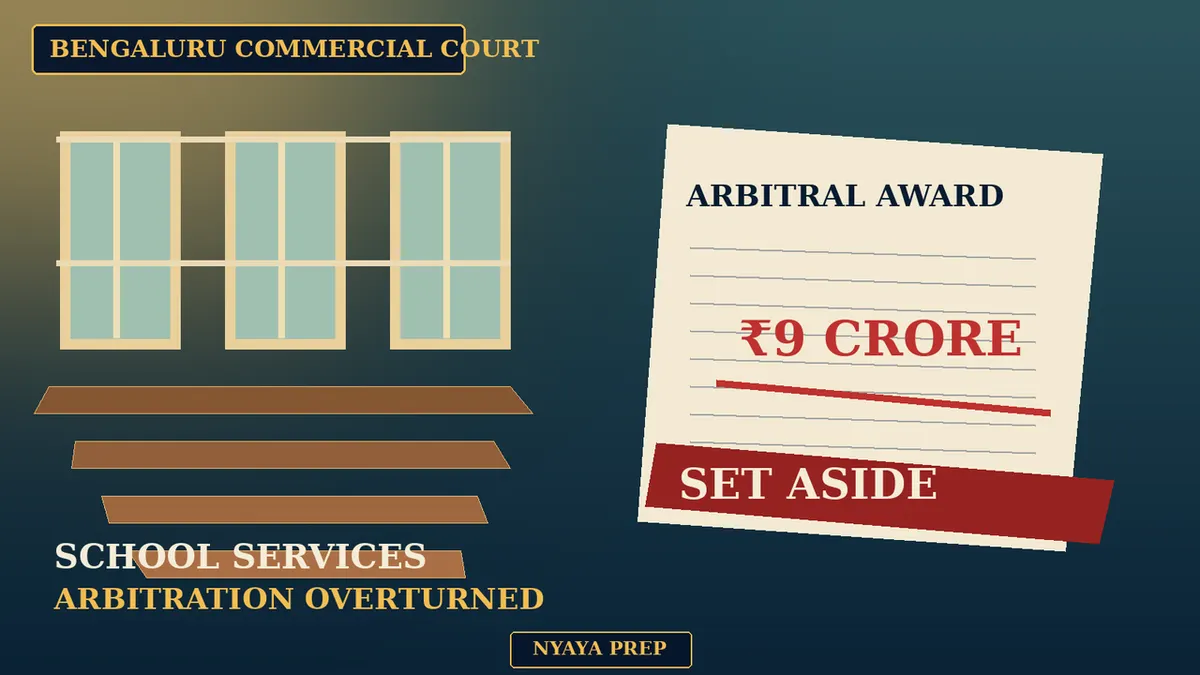
The school services contract
The dispute arose from a 2013 tender for annual maintenance of UPS systems, printers and LCD projectors at 1,763 government high schools and 2,633 aided schools in Karnataka. Puthur Infotech secured the contract for the period from April 2014 to April 2015. The original contract value was approximately ₹7.19 crore, of which the department paid about ₹5.07 crore. The company asserted that it had performed the contracted work and that further sums remained unpaid.
The department disputed the quality of performance and alleged deficiencies reported from several districts. Puthur approached the Micro and Small Enterprises Facilitation Council in 2018, after which the dispute reached arbitration. In May 2023 the arbitrator awarded approximately ₹7.75 crore with interest and another ₹1.27 crore with interest, along with fees and expenses. The department's counterclaim for alleged losses of ₹4.34 crore was rejected.
Limitation was a central defence
The department challenged the award under Section 34 of the Arbitration and Conciliation Act, 1996. It argued that the arbitrator had not decided whether the claims were filed within the limitation period, even though the objection appeared in its statement of defence and counterclaim. The company contended that the limitation plea was insufficiently raised and that payment discussions and assurances affected when time began to run.
The commercial court examined the pleadings and the invoice material. It found that sixteen of the seventeen invoices were time-barred on the relevant record, while one was not. Crucially, the arbitrator had failed to record a finding on the limitation objection. The court treated that omission as a serious failure to consider a material defence, rather than a harmless procedural defect.
Why the whole award fell
The court explained that the award was made as a lump sum including claims and interest across multiple invoices. Although one invoice was not barred by limitation, its amount could not be separated cleanly from the overall award. Because the defect affected the reasoning and structure of the decision, the court set aside the entire main award instead of preserving a portion through its own recalculation.
The additional award had required return of bank guarantee documents. As that direction depended on the main award, it too was set aside. This was a ruling on the legal sustainability of the awards. It should not be presented as a final finding that the company performed no services or that the department's factual complaints were all proved.
MSME counterclaims and the limits of arbitration review
A separate question concerned the department's counterclaim. The arbitrator had rejected it on the view that the department first needed to approach the MSME Council. The court disagreed with that premise, observing that the statutory conciliation and arbitration route for a supplier's unpaid dues does not automatically require a buyer to institute an independent Council proceeding before raising a counterclaim in the resulting arbitration.
The judgment also discussed the distinction between an objection actually raised during arbitration and a new objection introduced after the event. The court did not accept every argument advanced by the department; for example, it treated a late challenge concerning the supplier's MSME status differently because the objection had not been properly taken before the arbitrator. The case therefore illustrates both the importance of addressing pleaded defences and the limits on reviving waived objections.
Practical consequence
The Section 34 petition was allowed and both awards were set aside in their entirety. No fresh monetary award in favour of either party was made by this judgment. The parties' subsequent options, if any, must be assessed under the applicable arbitration law and procedural orders. For MSME-related arbitrations, the immediate lesson is that limitation and properly raised counterclaims require reasoned adjudication before a large award can safely withstand judicial scrutiny.
- Section 34
- MSME Arbitration
- Karnataka Schools
- Limitation