HC
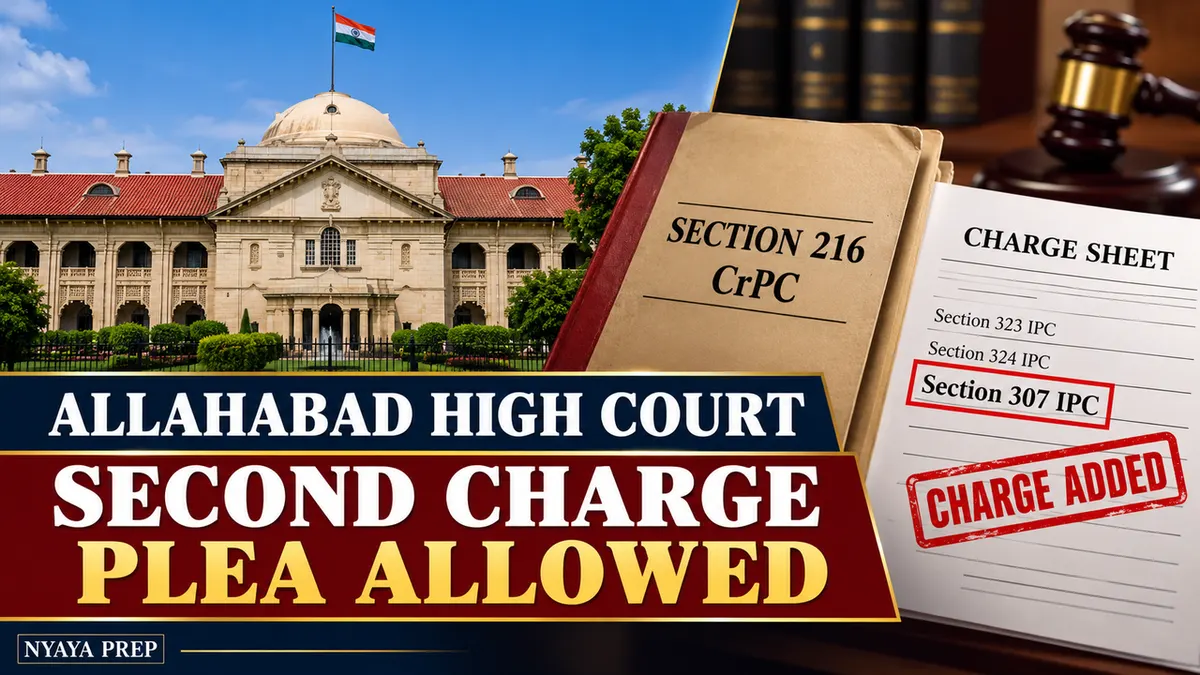
Allahabad High Court Upholds Second Application to Add Attempt-to-Murder Charge During Trial
Nyaya Prep • Published • Updated • 3 min read
High Court refuses to interfere
Justice Saurabh Srivastava delivered judgment on 26 October 2026 in Raghvendra Pratap Singh v State of Uttar Pradesh and another, Application under Section 528 BNSS No. 27503 of 2026. The accused sought quashing of a trial court order dated 4 June 2026 adding Section 307 of the Indian Penal Code to the charges. The High Court dismissed the application after examining both the procedural history and evidence recorded during trial.
The ruling addresses a practical criminal-procedure question: whether an earlier rejection of a request to add a charge prevents a later application seeking the same alteration. The answer depended on the timing of the request and the material before the trial court, rather than on a rigid prohibition against repeat applications.
From the FIR to the second application
The prosecution arose from an incident alleged to have occurred in Basti district in May 2021. The informant alleged assault with sticks and firing of a weapon during a confrontation. After investigation, the accused were summoned on charges including rioting, causing hurt, intentional insult and criminal intimidation. Section 307 IPC was not included at that stage.
The informant first sought addition of the attempt-to-murder charge in August 2022. The sessions court rejected that application as premature in September 2022. After charges were framed and the trial progressed, testimony was recorded from the injured informant, another witness and the doctor. The informant made a second request in March 2023, which the trial court allowed in June 2026.
The significance of trial evidence
The accused argued that the earlier rejection should prevent reconsideration and that no adequate fresh material justified adding Section 307. The State and complainant opposed that position. The High Court examined the doctor’s testimony, which described an injury consistent with a firearm entry wound on the informant’s thigh. The informant’s own trial testimony also referred to a firearm injury.
The judge concluded that the record provided prima facie material supporting the added charge. That assessment concerns whether the accused should face the charge, not whether guilt under Section 307 has been proved beyond reasonable doubt. The trial must still determine the offence according to the evidence and applicable legal standards.
How Section 216 operates
Section 216 of the Code of Criminal Procedure, 1973 permits a court to alter or add a charge at any time before judgment is pronounced. The provision also contains safeguards requiring the alteration to be explained to the accused and addressing possible prejudice, including adjournment or a fresh trial when appropriate.
The High Court treated the power as continuing during trial. An application rejected as premature before evidence was led does not automatically prevent a subsequent request when the trial has developed. The relevant question is whether the proposed addition is legally supported at that stage and whether the trial court exercises its statutory power properly. The equivalent modern framework is found in Section 239 BNSS, but this case concerned Section 216 CrPC.
Outcome and limits of the decision
Finding no illegality or perversity in the trial court’s decision, the High Court dismissed the challenge under Section 528 BNSS. The additional Section 307 charge therefore remains part of the trial as directed. The Court did not convict the accused or decide the eventual credibility of every prosecution witness.
The decision is useful for judges and practitioners managing evolving trial records. It clarifies that criminal charges are not necessarily frozen at the first framing order, while the power to alter them must remain anchored in evidence and the statutory safeguards protecting the fairness of the proceedings.
An additional procedural safeguard deserves attention: when charges change, the court must explain the alteration and consider whether the defence or prosecution needs further opportunity to meet it. The judgment upholding the second application does not dispense with those requirements. It simply confirms that the earlier premature rejection did not exhaust the trial court's statutory authority to respond to later evidence.
- Allahabad High Court
- Section 216 CrPC
- Alteration of Charge
- Attempt to Murder
- Criminal Procedure