HC
Allahabad High Court Rules IPC Section 467 Forgery Is Serious, Not Heinous, for Juvenile Justice Classification
Nyaya Prep • Published • Updated • 4 min read
Juvenile trial transfer set aside
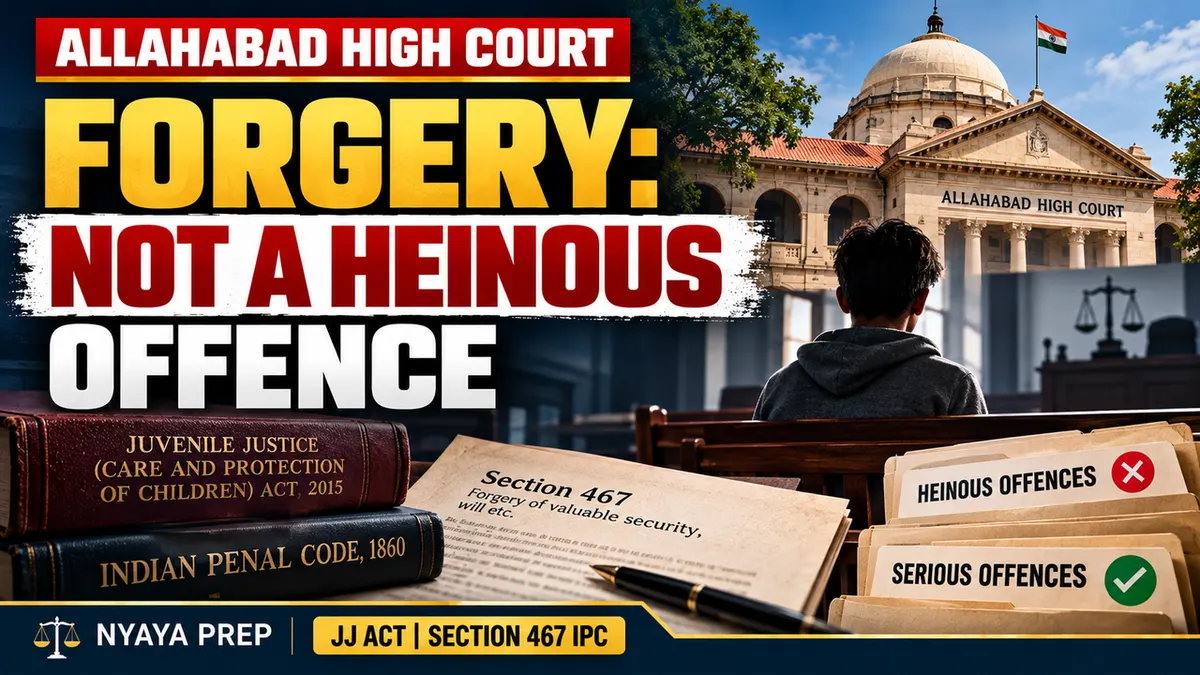
The Allahabad High Court held that an offence under Section 467 of the Indian Penal Code is not a heinous offence for purposes of the Juvenile Justice (Care and Protection of Children) Act, 2015 merely because its maximum punishment can be life imprisonment. Justice Jai Prakash Tiwari held that the provision does not prescribe a minimum term of seven years, the critical statutory feature for the heinous-offence category. The Court allowed a juvenile’s criminal revision, set aside the orders sustaining transfer to the Children’s Court for an adult trial, and directed the Juvenile Justice Board to proceed under the framework for serious offences. The judgment was delivered on 27 October 2026 in Criminal Revision No. 4845 of 2026.
The underlying forgery prosecution
The prosecution arose from an FIR registered at Khurja Nagar, Bulandshahr, in June 2016, alleging cheating and fraud involving approximately ₹40 lakh. Charges included Sections 419, 420, 467, 468, 471 and 120-B IPC. The revisionist was found to have been 16 years, nine months and seven days old at the relevant time. The Juvenile Justice Board initially treated the alleged offence as heinous, conducted a preliminary assessment under Section 15 and, in May 2022, recommended trial as an adult. The record later moved through the Children’s Court and the Board, producing conflicting procedural decisions about whether the case belonged in the serious-offence category.
Why the punishment wording mattered
Section 2(33) of the Juvenile Justice Act defines heinous offences by reference to a minimum punishment of imprisonment for seven years or more. Section 467 IPC, concerning forgery of valuable security, wills and specified documents, provides for life imprisonment or imprisonment extending up to ten years with fine, but does not stipulate a seven-year minimum. The distinction between maximum punishment and mandatory minimum punishment is therefore decisive. A provision cannot be treated as heinous merely because the highest available sentence is severe. The High Court relied on the Supreme Court’s approach in Shilpa Mittal v. State (NCT of Delhi), which addressed offences with maximum punishments exceeding seven years but no corresponding statutory minimum.
Procedural consequences for the child
The categorisation determines which forum and safeguards apply. Section 15 permits preliminary assessment for certain children aged sixteen or above accused of heinous offences; it is not a general mechanism for sending every serious case to adult trial. Section 18(3) governs transfer to the Children’s Court following the relevant statutory assessment. In this case, the earlier transfer decision could not survive once the offence was correctly classified. The High Court directed the Board to conduct the inquiry according to the procedure for serious offences, rather than subject the revisionist to adult trial on the basis of an incorrect label. The decision concerns procedural classification, not an acquittal on the allegations of forgery.
Lessons for statutory interpretation
The ruling is significant because it shows why legal classification must begin with the enacted definition, not a general impression that the alleged conduct is grave. A maximum sentence of life imprisonment may sound more serious than a fixed seven-year minimum, but the legislature chose a particular threshold for the heinous category. Courts and Boards must apply that threshold faithfully. For judiciary-examination candidates, the distinction between petty, serious and heinous offences under the Juvenile Justice Act is essential, as is the connection between classification, preliminary assessment and forum of inquiry. Historical IPC references must also be retained when discussing offences alleged in 2016, even though the BNS now governs newer offences.
Operative direction and next stage
The High Court quashed the impugned decisions that had continued the adult-trial route and remanded the matter to the Juvenile Justice Board. The Board must now handle the proceedings under the serious-offence procedure, subject to the Act’s protective framework and any other lawful directions. The merits of the alleged fraud remain to be determined in the appropriate forum. The ruling does not suggest that forgery is unimportant or that a juvenile cannot face consequences. It insists that those consequences follow the correct statutory classification and that the special power to expose a child to an adult trial cannot be exercised on an erroneous understanding of minimum punishment.
Case Details
Case name: Juvenile - X v. State of U.P. and Another
Citation: Criminal Revision No. 4845 of 2026
Court: Allahabad High Court
Bench: Justice Jai Prakash Tiwari
Case number: Criminal Revision No. 4845 of 2026
Relevant Bare Act
Act: Juvenile Justice (Care and Protection of Children) Act, 2015; Indian Penal Code, 1860
Relevant provisions: 2(33); 2(54); 15; 18(3); 102; IPC 467
- Allahabad High Court
- Juvenile Justice Act 2015
- Section 2(33)
- Section 2(54)
- Section 15
- Section 18(3)
- Section 467 IPC
- Shilpa Mittal