HC
Allahabad High Court Orders Demolition of Illegal Gulmohar Greens Towers and FIR Against Promoter
Nyaya Prep • Published • 3 min read
What the High Court ordered
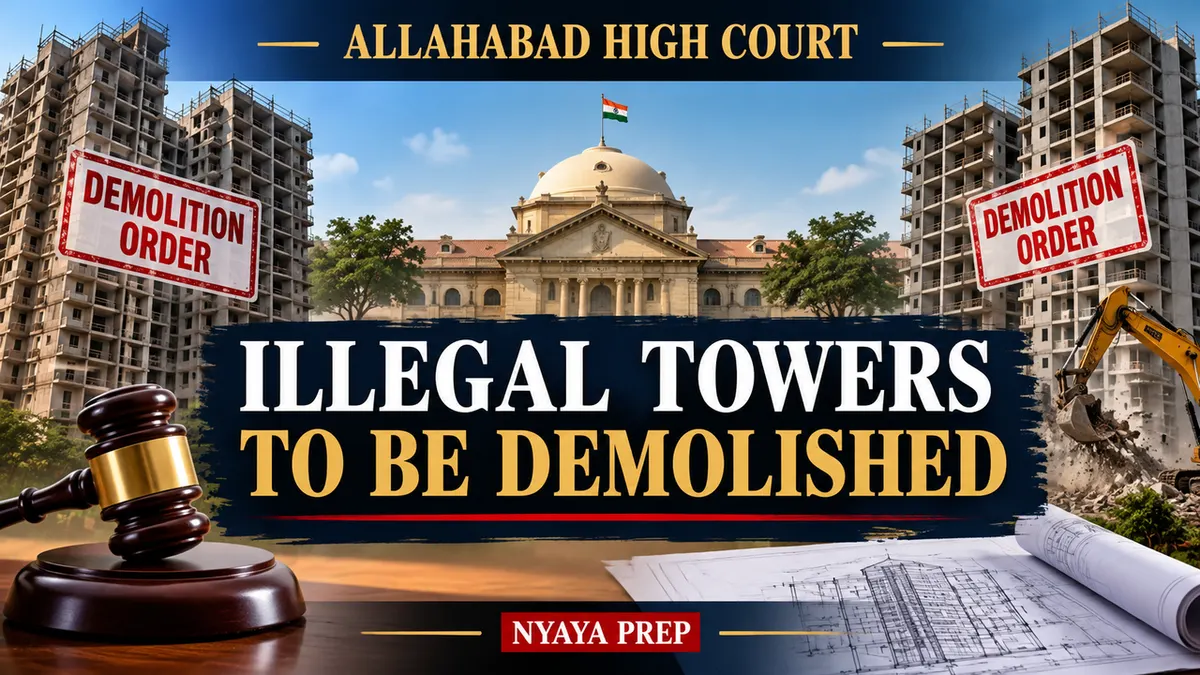
A Bench of Justices Saral Srivastava and Sudhanshu Chauhan ordered demolition of Towers 27 and 28 and the ninth and tenth floors of Towers 16, 17, 18 and 19 within two months. The directions concern the particular constructions found unlawful in the litigation. The Court also ordered registration of an FIR against the promoter within two weeks. Investigation of the alleged offences was assigned to an officer not below the rank of Additional Commissioner of Police, Ghaziabad. These directions were accompanied by financial orders and an inquiry into the role of public officials.
Dispute over sanctioned plans
The petitions arose from objections by residents and their association to departures from the residential project's approved scheme. According to the petitioners, the promoter had originally proposed 34 towers with 904 units in 2006, but additional structures were subsequently raised. The petitioners alleged that Ghaziabad Development Authority repeatedly regularised the construction through compounding orders despite the violations. The High Court examined the legality of those approvals and the impact on apartment purchasers who had relied upon representations about common facilities and the approved layout.
Findings on the developer and officials
The Court found that the disputed construction was not capable of lawful compounding and criticised the former Vice Chairman of the development authority for permitting compounding despite knowledge of the breaches. It recorded findings of collusion between authority officers and the promoter. It also concluded that the promoter had misrepresented material facts and dealt with common areas in a manner prejudicial to apartment owners. These are judicial findings in the reported decision; the FIR direction is a separate step and does not itself establish criminal guilt for any future prosecution.
Costs, compensation and administrative accountability
The promoter was directed to deposit ₹25 lakh into the account of the residents' welfare association. The development authority was directed to pay ₹50,000 each to eleven petitioners who had incurred the burden of litigation. A disciplinary inquiry was also directed against the former Vice Chairman for dereliction of duty. The combination of orders is significant because the Court did not confine relief to demolition. It addressed the costs of obtaining compliance, alleged misuse of regulatory powers, and the need for scrutiny of official decisions that had facilitated the disputed building activity.
Why the decision matters
Residential purchasers often depend on sanctioned plans, disclosures about common areas, and effective enforcement by planning authorities. When unlawful additions are retrospectively regularised, the interests of existing residents may be affected even though they did not participate in the developer's later decisions. This case illustrates that a compounding power is not unlimited and that a court can examine whether the statutory preconditions for its exercise were met. It does not mean every deviation from a building plan automatically requires demolition; the nature of the breach and applicable law remain decisive.
Implementation and next steps
The demolition directions carry a two-month implementation period, while the FIR must be registered within two weeks from the judgment. The disciplinary process and payment directions require separate administrative action. Residents and officials will therefore have to distinguish the Court's final findings about the legality of construction from the future investigation of alleged offences. Any challenge, stay, or modification of the judgment would have to be assessed from subsequent judicial records; none is assumed here. The reported order marks a substantial intervention in the governance of this particular housing society.
Case Details
Suresh Chander and ten others v State of Uttar Pradesh and others; Allahabad High Court; Bench: Justices Saral Srivastava and Sudhanshu Chauhan.
- Allahabad High Court
- Illegal Construction
- Ghaziabad
- Apartment Owners
- Urban Development