HC
Allahabad High Court Grants Azam Khan and Son Bail but Refuses to Stay Dual-PAN Convictions
Nyaya Prep • Published • Updated • 4 min read
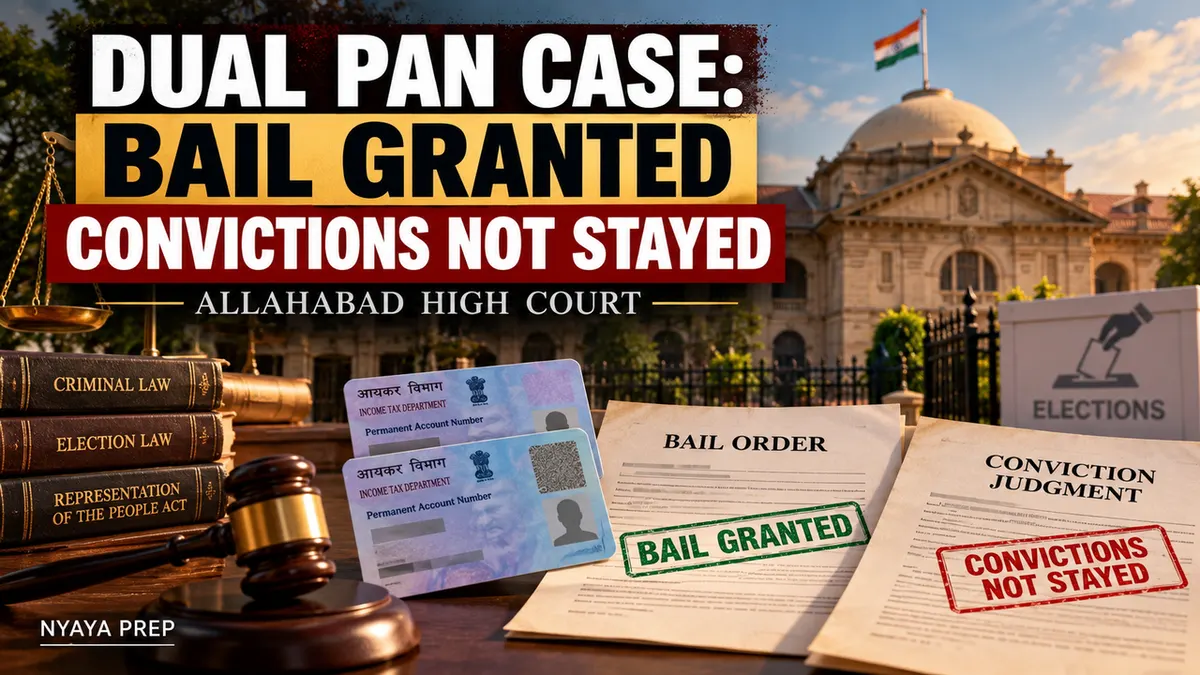
Two distinct requests and two different outcomes
Justice Samit Gopal decided applications in Criminal Revision Nos. 3893 and 3685 of 2026 by an order delivered on 29 October 2026. The Court permitted the revisionists to be released on bail following acceptance of the prescribed personal and surety bonds, taking account of the period of imprisonment already undergone and the fixed-term sentences.
The judge simultaneously refused to stay the underlying convictions. The criminal revisions were admitted and expedited, with final hearing listed for the third week of January 2027. The Court has therefore not acquitted either applicant or overturned the trial court’s findings. Their challenges to guilt and punishment remain to be determined on merits.
Allegations and the procedural history
The prosecution originated in a December 2019 complaint alleging that Abdullah Azam Khan used a second Permanent Account Number document bearing a different date of birth while contesting the 2017 Uttar Pradesh Assembly election. The prosecution alleged a conspiracy involving his father and the use of altered documents to overcome age-related eligibility requirements.
A Rampur special MP/MLA magistrate convicted the two men in November 2025 for conspiracy, cheating and forgery-related offences under the Indian Penal Code. Subsequent appellate proceedings enhanced certain prison terms, producing a maximum term of ten years for Azam Khan and seven years for Abdullah Azam Khan. Those convictions and sentences are now under revision before the High Court.
The defence argued that the case raised substantial legal questions, including double jeopardy, and stressed the custody already undergone. It submitted that Azam Khan had served over four years and Abdullah Azam Khan more than three and a half years. These contentions were made in support of interim relief and should not be mistaken for findings resolving the revisions.
Why bail was granted
The High Court considered the nature of the alleged occurrence, the fixed length of the prison terms, and the substantial period spent in custody. In those circumstances, it found suspension of sentence appropriate pending revision. The decision is an interim criminal-process measure that permits release while a higher court examines the conviction.
The Court did not accept that the same circumstances necessarily justified suspending the conviction. It treated the requests as legally separate. A sentence may be held in abeyance without making the conviction legally inoperative. That distinction has immediate consequences where a person seeks to contest an election.
Election disqualification and the higher threshold
Section 8(3) of the Representation of the People Act, 1951 provides for disqualification following conviction and a qualifying term of imprisonment. The Court reviewed Supreme Court precedents explaining that a stay of conviction is exceptional and requires special circumstances; it is not an automatic consequence of bail or suspension of the sentence.
Justice Gopal referred to the applicants’ criminal antecedents and previous convictions while rejecting the request to suspend their convictions. The order noted that the potential political consequences were not sufficient, on the record before it, to justify this extraordinary interim relief. Those observations do not replace a final determination of the pending revisions.
For lawyers, the order illustrates the need to distinguish three questions: whether custody should continue during appeal, whether the conviction itself should operate pending appeal, and whether the conviction is ultimately sustainable. The first question was answered in the applicants’ favour; the second was not; the third remains open.
What happens next
The trial court will process the bail bonds and transmit copies to the High Court record. The revisions will return for expedited final hearing in January 2027. Until a competent court changes the position, the convictions remain operative despite the suspension of imprisonment.
The order should not be reported as a judicial clearance of the election-document allegations. Its immediate significance is the controlled grant of liberty during continuing appellate review, alongside the Court’s refusal to neutralise the legal effect of conviction.
Case Details
Case: Mohd Azam Khan v. State of U.P. & 3 Ors.; Mohd Abdullah Azam Khan v. State of Uttar Pradesh & Ors.
Citation: Criminal Revision Nos. 3893 and 3685 of 2026; neutral citation not verified
Bench: Justice Samit Gopal
Advocates: Abhishek Manu Singhvi and N.I. Jafri, assisted by Shashwat Anand, for revisionists; Anoop Trivedi for State; Sharad Sharma for informant.
Relevant Bare Act
Indian Penal Code, 1860: Sections 120B, 420, 467, 468 and 471
Representation of the People Act, 1951: Section 8(3)
- Allahabad High Court
- Criminal Revision
- Bail
- Election Disqualification
- PAN
- Azam Khan