HC
Allahabad High Court Directs Police to Disclose Current Criminal Case Status in Passport Verification Reports
Nyaya Prep • Published • Updated • 4 min read
Why the passport application reached the Court
The Allahabad High Court has directed the Uttar Pradesh police leadership to improve the information supplied during passport verification. The direction arose from a writ petition concerning the re-issuance of a passport, but its significance extends beyond the individual applicant. The Court found that police reports must describe the present procedural position of a criminal case, not simply reproduce a crime number or refer to an old charge-sheet.
The petitioner, Suresh Yadav, also described in the proceedings as Geeta Saran Yadav, approached the Court because an application for passport re-issuance submitted on 12 May 2026 remained undecided. The obstacle was a police verification report referring to a criminal case. The State subsequently placed instructions before the Court showing that investigators had submitted a closure report concerning the petitioner, although a charge-sheet had been submitted against another accused, Ram Dhyan.
The State instructions also recorded that the petitioner had no criminal history. These were the circumstances in which the Court considered the passport application. Importantly, the existence of a closure report and the judicial acceptance of that report are not necessarily the same event. The Court therefore addressed what a useful verification report should disclose about both a charge-sheet and a final or closure report.
The specific information police must provide
A Division Bench of Justices Ajit Kumar and Garima Prashad observed that the police cannot deal with passport verification mechanically. It is inadequate to give the case crime number alone or merely state that a charge-sheet has been prepared. The report must tell the passport authority what has actually happened in the criminal proceedings and what remains pending.
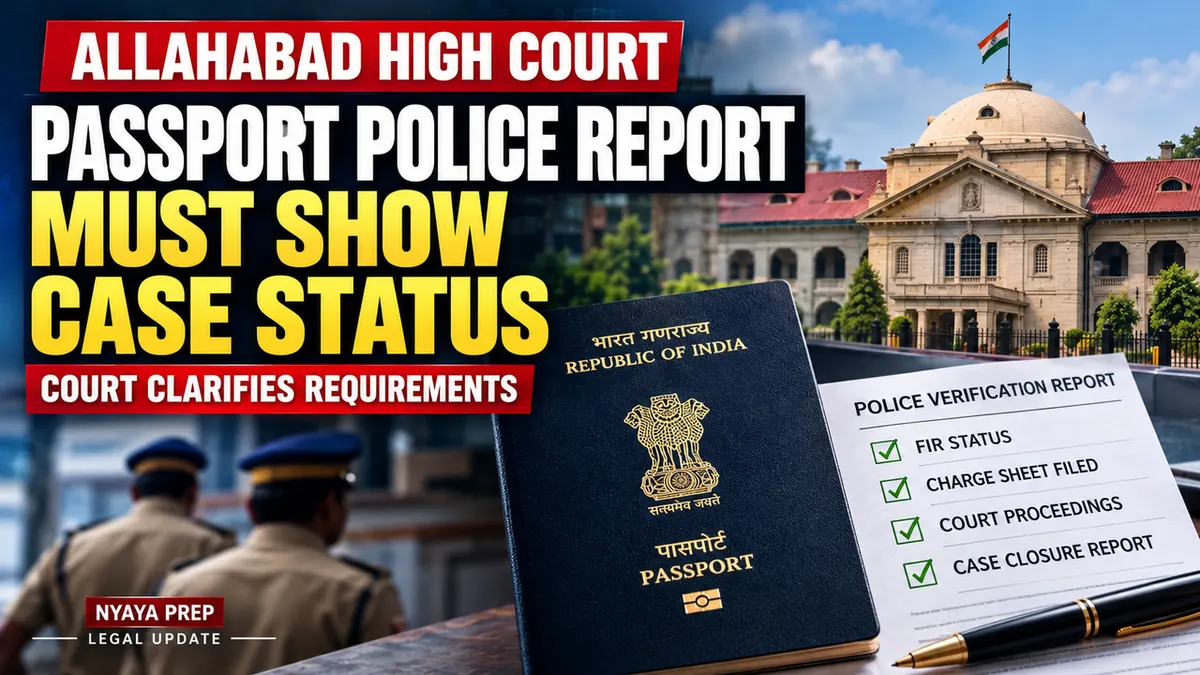
The order requires a report to identify whether a charge-sheet has been filed before the competent court against the passport applicant. If it has, the report must say whether the court has taken cognizance. It must also explain the current status of the charge-sheet, including whether the document has not yet been submitted to court. Where a closure or final report has been filed, the verification should state whether the Magistrate has passed an order on it.
If a trial has commenced, the police report must disclose its present status. These distinctions are important because a person named during investigation may occupy a very different legal position from someone against whom cognizance has been taken or whose trial is proceeding. An incomplete report can obscure that distinction and delay an administrative decision without explaining the actual legal obstacle.
Directions to the passport authority and State police
For the petitioner, the Court directed the Regional Passport Officer to decide the pending re-issuance application after verifying academic records, date of birth, names and other relevant particulars. The officer must dispose of the application within six weeks from production of a certified copy of the order. The High Court did not direct unconditional issuance of a passport without these checks.
For the wider verification process, the Court directed the Director General of Police, Uttar Pradesh, to ensure that the police verification form includes the procedural details identified in the order. The State must submit a compliance affidavit through the Registrar General. The matter is listed for 4 November 2026 for the limited purpose of monitoring compliance with this direction.
The underlying order is dated 13 October 2026 and was reported on 27 October. It arose in Writ-C No. 35451 of 2026, a proceeding invoking the High Court’s constitutional writ jurisdiction. The operative directions are directed to the Uttar Pradesh authorities; they should not be described as an automatic nationwide amendment to passport rules.
Why the ruling matters
Police verification is often the factual bridge between a passport applicant and the authority deciding whether to grant or re-issue a travel document. If the report does not distinguish an allegation, a charge-sheet, cognizance, a pending trial and a closure report, the decision-maker may act on a misleadingly incomplete account of the case. The Court’s approach requires greater procedural precision rather than an assumption that every mention of an FIR has the same consequence.
For lawyers and judiciary-examination candidates, the decision illustrates the practical operation of Article 226 of the Constitution. The Court addressed an individual grievance and also required the administrative reporting mechanism to be improved. The decision does not determine the petitioner’s criminal guilt, and it does not dispense with independent verification of identity or other passport requirements.
The next verifiable steps are the passport authority’s decision within the prescribed period and the State’s compliance affidavit before the High Court. Whether any wider administrative instructions are issued, and how the police revise their forms, will depend on the authorities’ subsequent action and the Court’s review.
Case Details
Case name: Suresh Yadav @ Geeta Saran Yadav v. Union of India and 6 Others
Court: Allahabad High Court
Bench: Justices Ajit Kumar and Garima Prashad
Order date: 13 October 2026
Case number: Writ-C No. 35451 of 2026
Relevant Bare Act
Constitution of India: Article 226: High Court writ jurisdiction
- Allahabad High Court
- Passport Verification
- Article 226
- Police Verification
- Criminal Proceedings
- Writ Petition