Criminal Procedure
Allahabad High Court Demands UP Home Department Explanation for Year-Long Charge-Sheet Delay
Nyaya Prep • Published • Updated • 4 min read
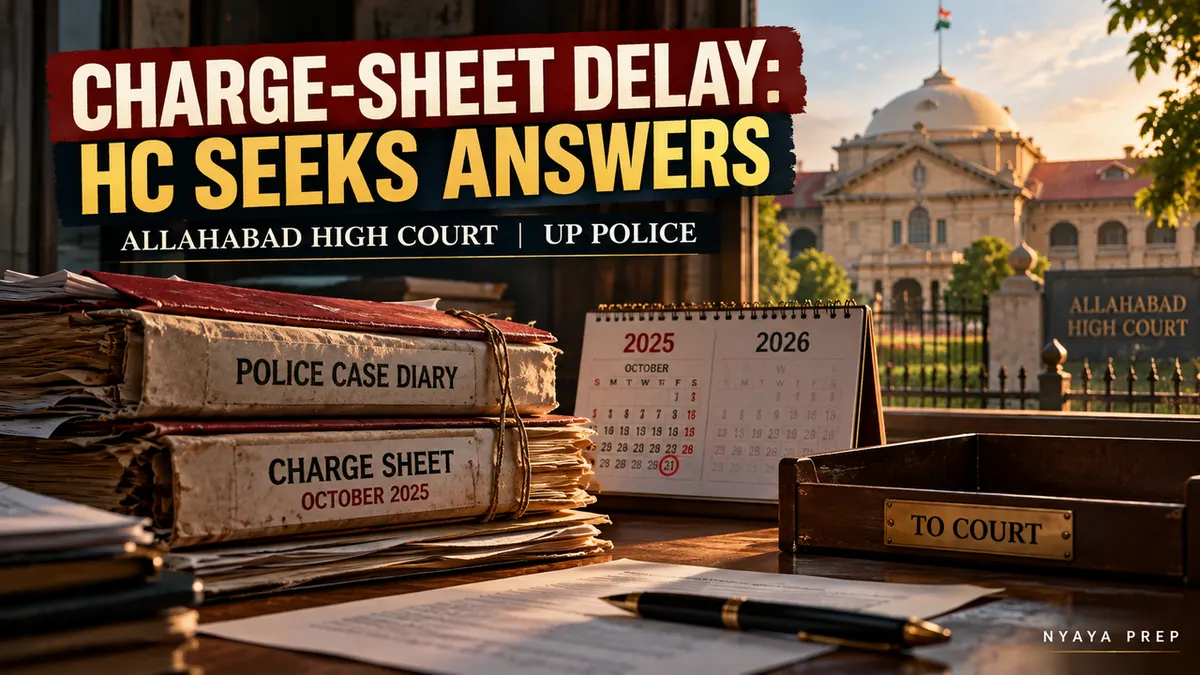
High Court seeks personal explanation from senior official
The Allahabad High Court has directed the Additional Chief Secretary (Home), Uttar Pradesh, to file a personal affidavit explaining why a charge-sheet prepared nearly a year earlier had still not been submitted to the competent court. Justices Abdul Moin and Rajeev Bharti also sought information on remedial or punitive steps proposed to address such delays. The order arose from a petition seeking progress in a criminal investigation.
The Court expressed concern about inconsistent instructions reaching it during successive hearings. Its intervention is procedural: it requires an accountable explanation and timely action. It is not a judgment determining whether the allegations in the underlying criminal case are true.
The timeline placed before the Court
The petitioner, Niharika Mishra, complained that the police had not filed a charge-sheet in a case involving allegations of criminal intimidation and transmission of obscene material. During an earlier hearing on 25 August 2026, the Court had been informed that the charge-sheet had been forwarded and was expected to be filed.
In the later hearing, the State stated that a charge-sheet dated 26 October 2025 had been prepared and forwarded to the Circle Officer on 20 December 2025. The Assistant Prosecution Officer had raised objections on 13 January 2026, following which the case was returned for further investigation. The Court found that this fuller history had not been conveyed when the earlier instructions were given.
Why the explanation was considered inadequate
The Bench questioned how a report said to have been drawn up in October 2025 could remain unfiled for so long. It also criticised the failure to place complete instructions before the High Court. Where an investigation has reached the stage of a proposed police report, repeated internal movement of the file must be capable of explanation.
The judges observed that litigants should not be left to withdraw or abandon proceedings on the strength of incomplete assurances that a charge-sheet is on its way. The issue is one of institutional responsibility: supervisory scrutiny cannot become a reason for indefinite inaction after the police say that the report is ready.
The procedural distinction that matters
Preparing a document internally, forwarding it to a superior and filing the required police report before a Magistrate are not identical events. The Court was concerned with the gap between these stages. The State indicated that objections had led to further investigation, but the Bench wanted an account of why the process remained unresolved for almost a year.
Although the report referred to a provision of the Bharatiya Nagarik Suraksha Sanhita while discussing transmission without delay, the precise statutory linkage should be checked against the judicial order and the current Code before treating any section number as controlling. The operative direction reported here is the demand for an affidavit and prompt handling of the pending report.
Three-week affidavit and possible personal appearance
The Additional Chief Secretary was directed to file the personal affidavit within three weeks. It must explain the failure to submit the charge-sheet and the repeated movement of the matter between supervisory authorities and the investigating officer. The affidavit must also address what corrective or disciplinary measures the government proposes in comparable situations.
The Court listed the case for 19 November. It directed that the senior official appear in person with the records if the affidavit is not filed. The Bench also expected the police report in the particular matter to be placed before the competent court expeditiously. These directions do not themselves decide the outcome of the criminal investigation.
Implications for police administration
The case illustrates why courts demand reliable status reports from investigating agencies. Inaccurate or incomplete instructions can mislead litigants and judges about the progress of a case, even when no intentional concealment has yet been established. Transparent records of objections, supervisory review and subsequent investigative steps are essential.
For complainants, a charge-sheet described as “prepared” is not necessarily a report filed in court. For the administration, the immediate task is to explain the chronology and identify a workable procedure to prevent reports from remaining in internal circulation without a clear decision.
Case Details
Case: Niharika Mishra writ petition concerning filing of police report
Bench: Justices Abdul Moin and Rajeev Bharti
Relevant Bare Act
- Allahabad High Court
- UP Police
- Charge Sheet
- Investigation
- Police Accountability