High Court Judgments
Allahabad High Court Calls Long-Term Contractual Engagement of KGBV Teachers Forced Labour, Issues Four-Month Directions
Nyaya Prep • Published • Updated • 4 min read
The Court’s directions
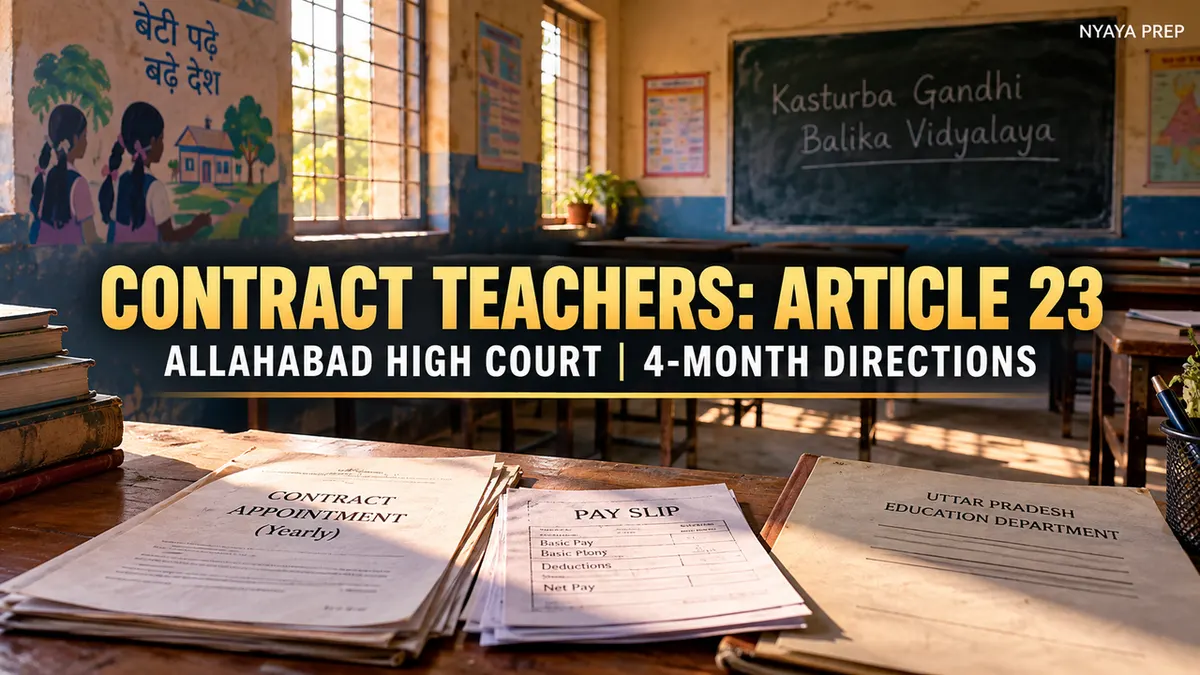
Justice Pankaj Bhatia directed the Uttar Pradesh Government to create teaching posts for Kasturba Gandhi Balika Vidyalayas, frame service conditions comparable with those of regularly appointed teachers up to Intermediate level, and consider eligible teachers’ claims for regularisation against the newly created posts. The State was also directed to revise honoraria periodically towards parity with teachers in government and aided schools. The principal administrative steps were to be taken within four months. The decision arose from petitions challenging prolonged contractual employment and inadequate remuneration.
Pending implementation, the Court directed payment of an honorarium of ₹17,000 per month from the date of judgment to all KGBV teachers, including those who were not petitioners, and extended the protection associated with Section 24(2) of the Right of Children to Free and Compulsory Education Act, 2009. The judgment does not itself declare that every contractual teacher has been automatically regularised. It requires the competent authority to consider regularisation in light of qualifications and length of service.
How the teachers were engaged
KGBVs were established to provide residential education for girls from disadvantaged backgrounds, initially under Sarva Shiksha Abhiyan and later within Samagra Shiksha. The teachers were selected through an advertised process and engaged under contracts renewed from year to year. Some petitioners had served for more than a decade. The Court noted an arrangement involving eleven months and twenty-nine days of service followed by a one-day break, despite the continuing need for teachers in schools operating over many years.
The record described part-time teachers receiving ₹12,790 monthly before a 25 per cent EPF deduction, leaving ₹9,592 in hand. Petitioners argued that they performed duties comparable to regular teachers but lacked security and reasonable remuneration. They also pointed to increases in honoraria for other categories of education workers. The State’s position that sanctioned posts were absent did not persuade the Court that indefinite precarious engagement was constitutionally acceptable for work that had become an ongoing public responsibility.
Constitutional and statutory reasoning
The Court considered Articles 14 and 23 of the Constitution together with the State’s education obligations under Article 21A and the RTE Act. It observed that the State could not advance the important goal of schooling disadvantaged girls by keeping the teachers who delivered that education in persistently insecure conditions. It treated the arrangement as a form of forced labour for constitutional purposes and found the unequal treatment inconsistent with the equality guarantee.
Under the RTE framework, the Court examined duties to provide teaching staff and to prescribe fair service conditions. It noted that teachers in KGBVs and other State-supported schools perform comparable educational functions, yet the former were denied ordinary service protections. The judgment also invoked the importance of constitutionally acceptable means when pursuing a socially valuable objective. A beneficial scheme cannot be insulated from scrutiny merely because its intended beneficiaries are disadvantaged students.
Implementation and wider significance
The judgment places immediate responsibilities on Uttar Pradesh to identify required posts, formulate conditions and assess individual claims. The Court clarified that the State could not defer compliance solely by waiting for the Centre’s share of funding; it could proceed and recover the appropriate contribution according to the funding arrangement. The direction to pay ₹17,000 in the interim provides a concrete short-term remedy while structural measures are taken.
The decision may influence debate about long-running contract work in publicly funded education, but its operative orders concern the KGBV teachers before the Court and the broader class identified in the judgment. It does not eliminate all contractual employment or fix an identical salary rule for unrelated schemes. The next significant development will be the State’s compliance with the four-month timetable and the individual regularisation assessments.
Case Details
Bench: Justice Pankaj Bhatia
Relevant Bare Act
Constitution of India: Articles 14, 21A and 23
Right of Children to Free and Compulsory Education Act, 2009: Sections 2(n), 7, 8 and 24(2)
- Allahabad High Court
- Article 23
- Teachers
- Education Law
- KGBV
- Right to Education